 follow us
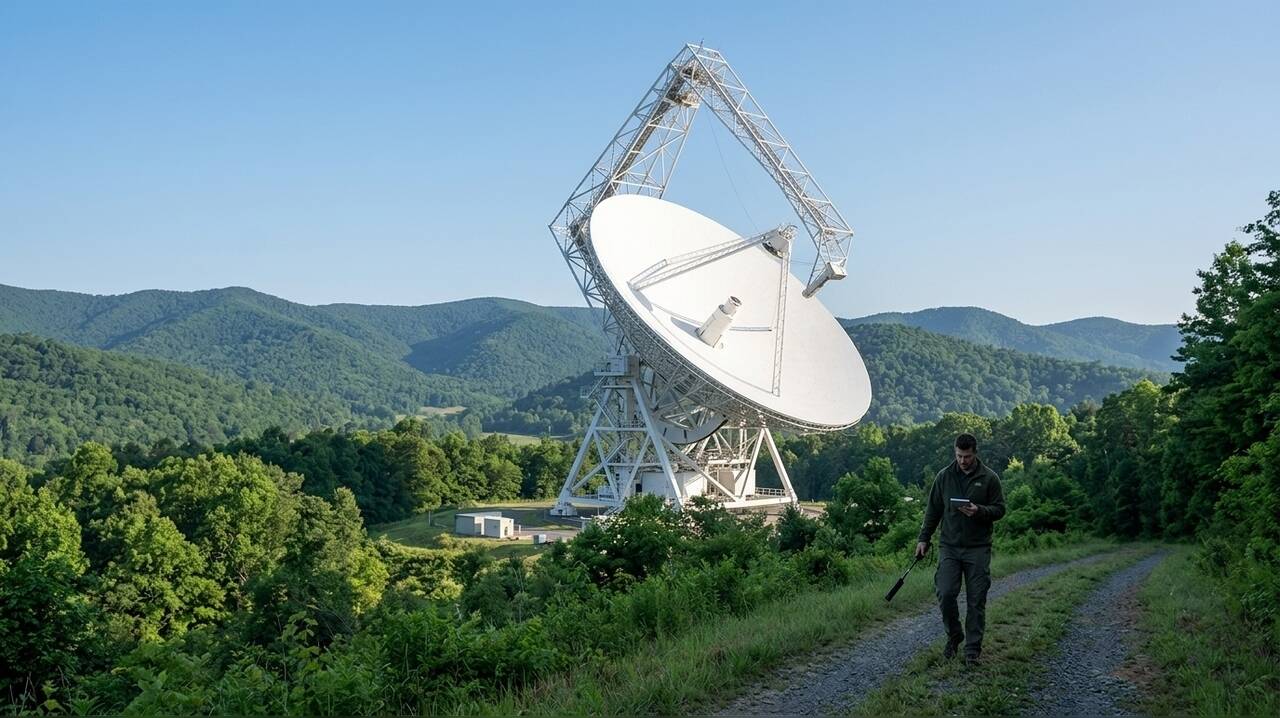
In the remote mountains of eastern
Establishment of the National Radio Quiet Zone
The National Radio Quiet Zone was officially designated by the Federal Communications Commission (FCC) in November 1958, following collaboration with the Interdepartment Radio Advisory Committee. The initiative aimed to minimize harmful radio interference affecting both the National
The boundaries of this quiet zone are defined by precise longitude and latitude coordinates, rather than following state lines or natural borders, making it one of the largest radio-restricted areas globally. This meticulous delineation underscores the importance of maintaining a serene environment for scientific research.
Protecting Sensitive Astronomical Research
The necessity for such a broad restricted area stems from the incredibly faint signals that astronomers aim to detect. The Green Bank Observatory explains that these signals are measured in units called Jansky, with the telescope often picking up signals as weak as milli- or micro-Janskys—so faint that they are likened to the energy of a single snowflake landing. Even a standard cell phone, located far away, would emit more energy than the cosmic signals researchers seek to study, necessitating stringent control over local radio frequency interference.
To enforce these protections, two overlapping legal frameworks are in place. The National Radio Quiet Zone mandates that any new or modified permanent radio transmitter within its limits must be coordinated with federal regulators. In contrast, the West Virginia Radio Astronomy Zoning Act imposes stricter regulations within a 10-mile radius of the telescope, making it illegal to operate any equipment that could interfere with radio wave reception.
Community Impact and Ongoing Research
Maintaining the quiet zone requires active monitoring. Staff from the National Radio Astronomy Observatory regularly patrol a 20-mile radius around the telescope, identifying sources of interference and working collaboratively with local residents to resolve issues. This cooperative approach contrasts sharply with the more common remote monitoring methods used elsewhere in the U.S.
Interestingly, Green Bank has attracted individuals who believe they suffer from health issues related to exposure to wireless signals, despite such conditions lacking recognition in mainstream medicine. For the town's residents, the absence of reliable cell service and Wi-Fi presents a daily challenge, yet they continue to embrace their unique lifestyle. Over six decades after the establishment of the National Radio Quiet Zone, Green Bank remains a vital hub for radio astronomy, contributing to research on the Milky Way and other cosmic phenomena, while its residents live in a community shaped by the need for electromagnetic tranquility.