
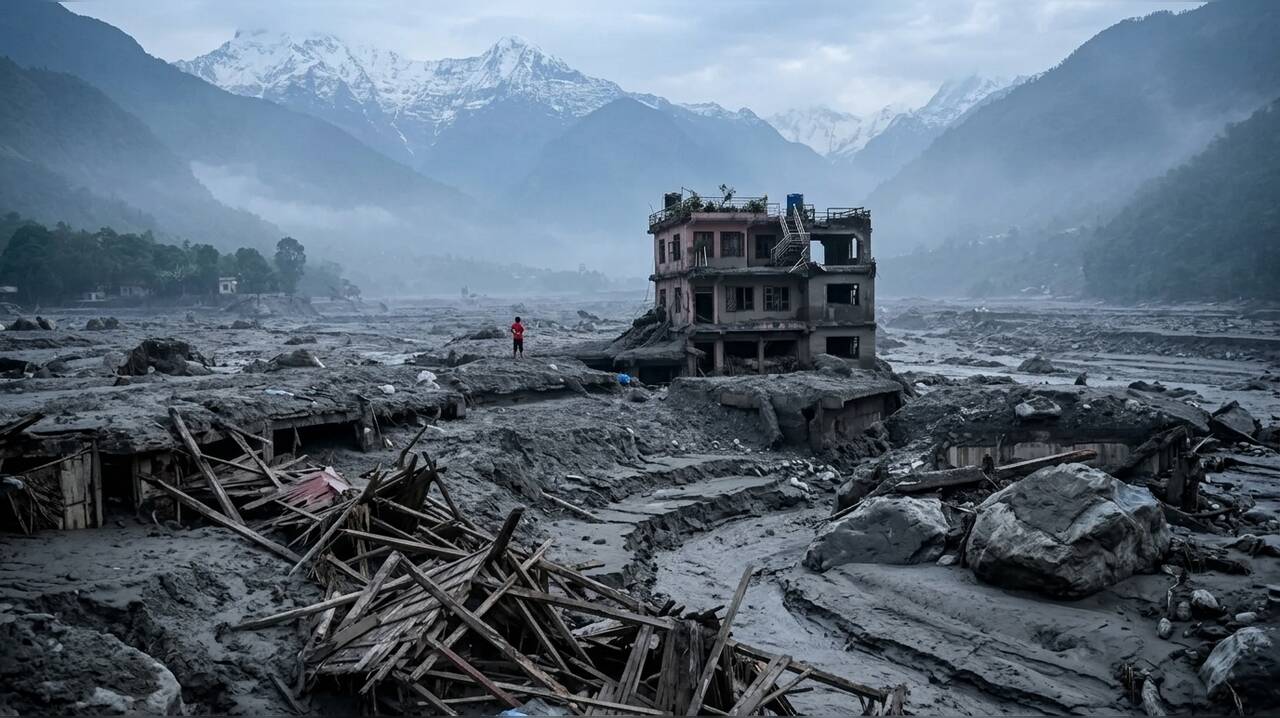
Nepal has formally petitioned the board of the Fund for Responding to Loss and Damage for urgent financial support following a devastating flash flood in the Bhotekoshi river basin. The disaster, which occurred on August 26, was triggered by a high-altitude glacial collapse near the Tibet-Nepal border, sending a massive surge of water, debris, and rock through multiple districts.
Emergency response operations have recovered more than 1,100 bodies to date, while nearly 4,500 individuals remain missing. The scale of the destruction has overwhelmed local resources, prompting the government to seek international intervention as a matter of moral and financial accountability.
A Shift Toward Climate Justice
In a significant shift in diplomatic strategy, the Nepalese government is framing the request not as a plea for traditional aid, but as a demand for climate justice. Foreign Minister Shisir Khanal stated that Nepal, despite contributing negligible greenhouse gas emissions, is disproportionately suffering the consequences of global warming. He argued that the rapid melting of Himalayan glaciers and the resulting mountain disasters are direct outcomes of a global crisis for which Nepal bears little responsibility.
Minister Khanal emphasized that the government intends to pursue this issue with firmness in international forums, asserting that major carbon-emitting nations have a moral liability to compensate vulnerable countries. He highlighted that the survival of the Himalayan glaciers is essential for the water security of over two billion people across South Asia who rely on river systems such as the Ganges and the Trishuli. According to the minister, Nepal is advocating for the broader survival of the region’s civilization.
Formal Claims and International Context
The formal request for assistance was delivered via a letter signed by Finance Minister Swarnim Wagle and the Minister for Forests and Agriculture, Geeta Chaudhary. The document acknowledges that while the full extent of the economic and non-economic damage is still being assessed, the immediate impact has far exceeded the country's capacity to respond. The appeal is directed toward the Fund for Responding to Loss and Damage, a mechanism established at COP27 and operationalized at COP28 to assist developing nations facing severe climate-related impacts.
The broader debate surrounding climate equity remains a central theme in these discussions. India has consistently advocated for a framework that accounts for historical emissions and the development needs of emerging economies. New Delhi maintains that developed nations, which utilized the majority of the global carbon budget during their industrialization, hold a primary responsibility to provide the financial resources necessary for climate-vulnerable countries to manage and recover from such catastrophes.




