
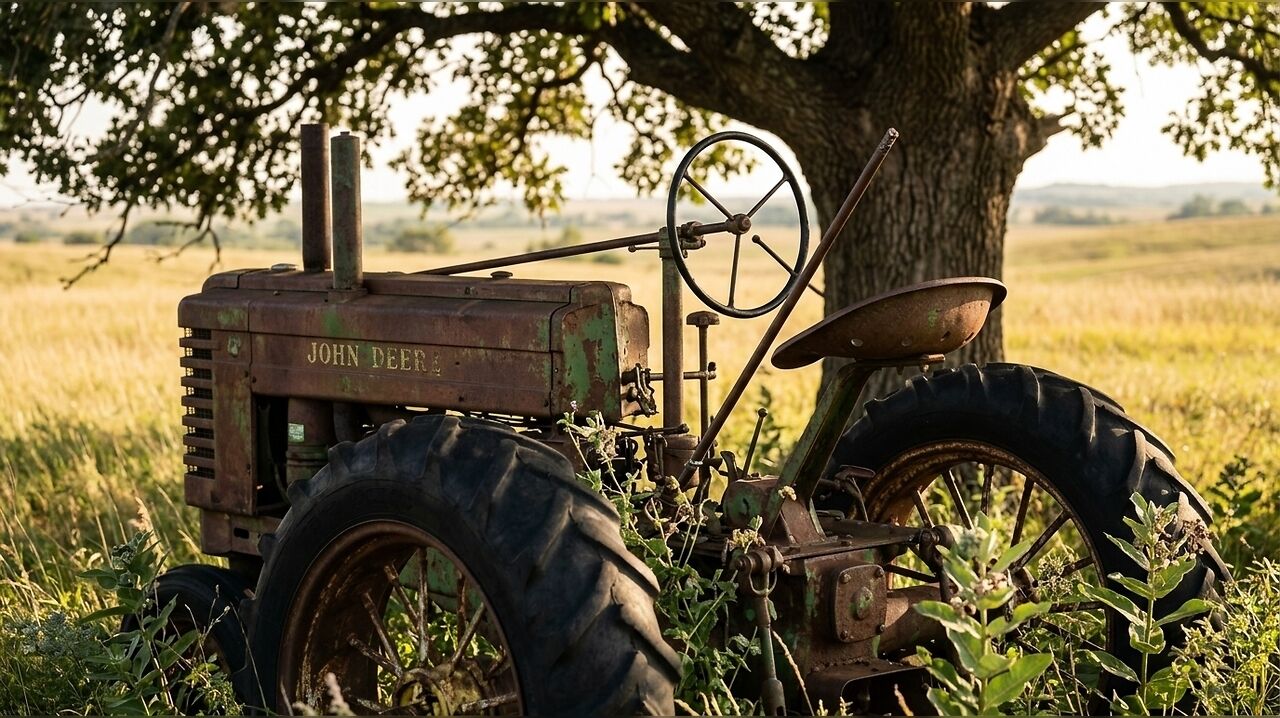
For many, family heirlooms are kept in attics or passed down through generations, but for
According to a report by Farm Progress, the tractor’s hand clutch had been tightened when Bruha was a young boy, making it difficult for him to operate. After an incident where he was unable to stop the machine at the end of a field, his father took the tractor to a local welder. The clutch rod was extended to provide the necessary leverage for a child to operate it safely from the driver’s seat. Years later, this specific alteration allowed Bruha to confirm the identity of the weathered tractor he discovered on a different Nebraska farm.
A Wartime Agricultural Legacy
The John Deere GM holds a unique position in the history of American agriculture. Introduced in 1942 during the latter stages of World War II, the 34-horsepower model was an evolution of the standard Model G. It was equipped with an electric starter, lights, a 412-cubic-inch engine, and a six-speed transmission. Its production was influenced by the Emergency Price Control Act, which saw the Office of Price Administration regulate the costs of agricultural machinery that had not undergone significant design changes during the conflict.
Between 1942 and 1947, approximately 13,000 units were manufactured, making the GM significantly rarer than the standard Model G, which saw a production run of roughly 64,000 units between 1937 and 1953. Due to wartime rubber shortages, some of the early GM tractors were originally fitted with steel wheels before later versions transitioned to rubber tires. Today, the model is considered a prized machine among vintage tractor collectors.
Restoration and Return
After finding the neglected tractor, Bruha successfully brought the machine back into his family’s possession. Following a full restoration, the tractor is no longer relegated to the fields where it once worked. Instead, it is now featured at parades and agricultural events, serving as a preserved example of mid-20th-century farming technology. The modification that was once a practical solution to a childhood difficulty ultimately became the key to reuniting the family with their long-lost heirloom.




