
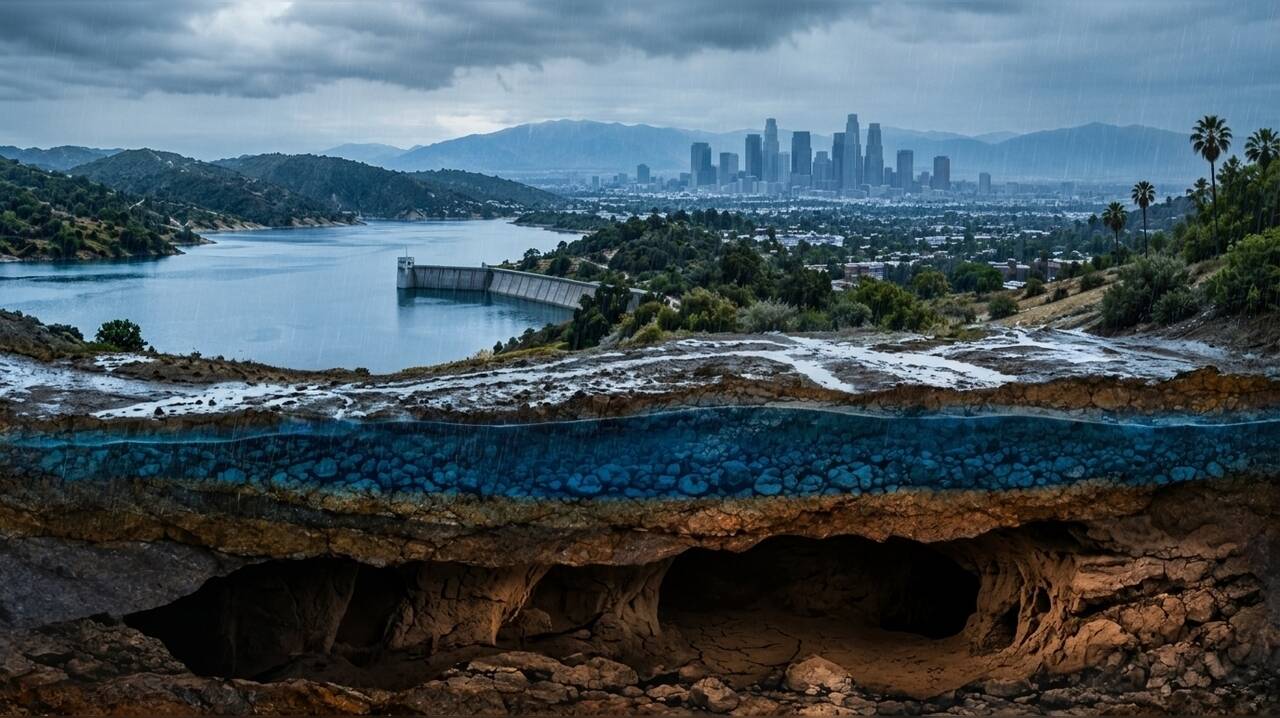
Historic rainfall across Southern California in 2023 provided significant surface-level relief, yet new research reveals that the region's deeper groundwater reserves remain largely depleted. While reservoirs and shallow aquifers saw a near-total recovery following a series of intense atmospheric-river storms, the underground water table at greater depths has failed to rebound at the same rate.
A study published in the journal Science indicates that aquifers located more than 50 metres below the surface have only regained approximately 25% of the water lost since 2006. The findings suggest that the dramatic visual improvement in the region's water landscape masks a more persistent, long-term deficit in deeper geological layers.
Disparity in Groundwater Recovery
The research, which tracked groundwater changes across the Greater Los Angeles area over two decades, highlights a clear distinction between how different water sources respond to precipitation. Surface water and shallow groundwater systems are highly responsive to seasonal weather patterns, allowing them to refill rapidly during exceptionally wet years. In contrast, water must filter through extensive layers of soil and rock to reach deeper aquifers, a process that is significantly slower and less efficient.
In urban environments like Los Angeles, the challenge is compounded by the prevalence of runoff, which prevents much of the rainfall from infiltrating the ground to replenish deeper reserves. Consequently, the study concludes that a single year of record-breaking precipitation is insufficient to reverse the cumulative impact of years of groundwater extraction and prolonged drought.
Innovative Monitoring Techniques
To assess these underground changes, researchers employed a unique methodology involving seismic ambient-field interferometry. By analysing seismic waves recorded by the region’s existing earthquake-monitoring network, the team was able to observe how these waves shifted as they travelled through subsurface materials with varying water content. This approach allowed scientists to create
Lead researcher Shujuan Mao noted that the findings serve as a critical reminder that surface-level indicators—such as reservoir capacity—do not provide a complete picture of a region's water security. The study emphasises that while the 2023 storms were beneficial, the legacy of long-term depletion remains stored beneath the surface. According to the research team, multiple consecutive wet years would be required to fully restore the deeper aquifers to their previous levels, as the current recovery remains far from complete.




