
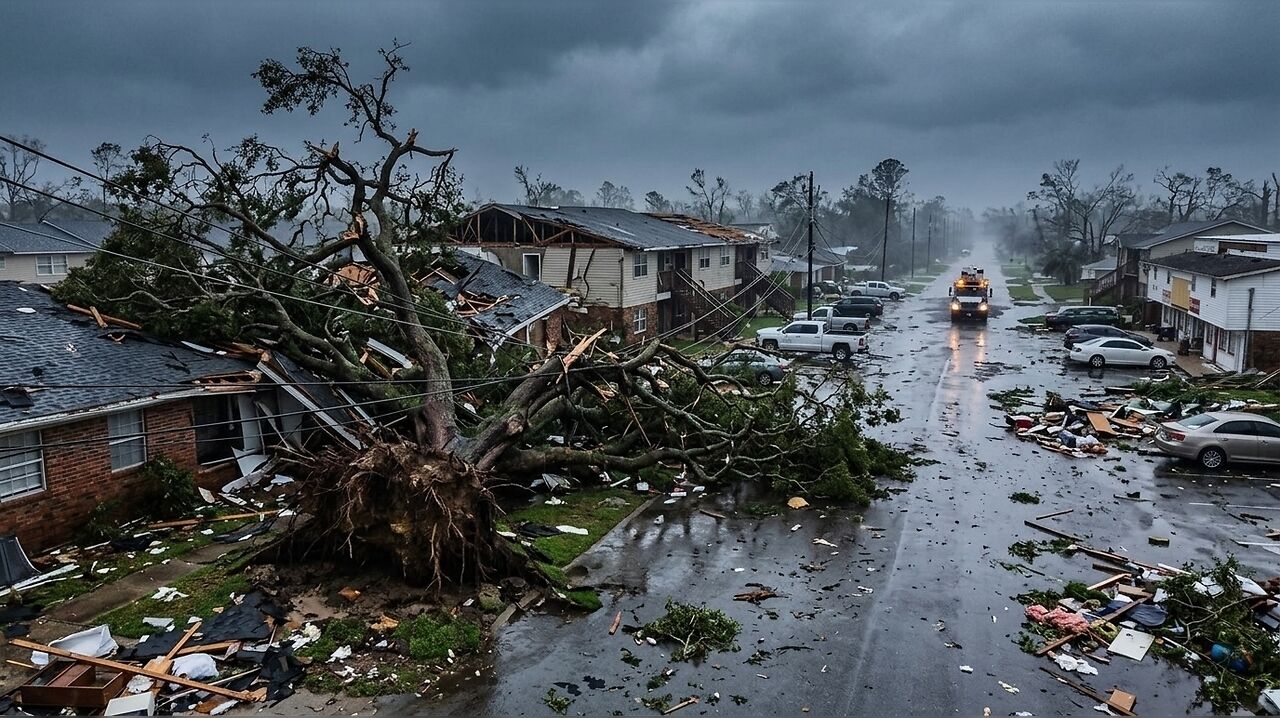
Authorities have confirmed two fatalities in Florida and two in Alabama. In Florida’s Escambia County, Sheriff Chip Simmons reported that one individual died when a tree collapsed onto a residence, while a second person succumbed to carbon monoxide poisoning after operating a generator in an inadequately ventilated garage. Four other individuals present at the scene of the carbon monoxide incident were hospitalized. In response, Florida Governor Ron DeSantis issued a public safety warning, emphasizing the lethal risks associated with improper indoor generator use.
Infrastructure Damage and Power Disruptions
The storm’s impact on regional infrastructure has been significant, with high winds stripping roofs from buildings, toppling trees, and damaging commercial properties. Notable damage was reported in Milton, Florida, where an apartment complex sustained structural roof failure, and in Gulf Breeze, where a petrol station canopy collapsed. Pensacola also experienced severe debris accumulation following the destruction of hotel roofing.
The widespread nature of the storm resulted in massive electricity disruptions. Estimates from Saturday indicated that between 670,000 and 900,000 customers were left without power, with Florida experiencing the highest concentration of outages, followed by Alabama, Georgia, and Mississippi. Utility crews have been deployed to conduct repairs as local officials continue to survey the extent of the damage to roads and buildings.
Ongoing Weather Threats and Emergency Response
Despite its transition to a post-tropical cyclone, Isaias continues to pose significant environmental risks. The National Hurricane Center has issued warnings regarding heavy rainfall, which is expected to cause flash and urban flooding throughout the Southeast and the southern Appalachian region. Authorities have also highlighted the potential for landslides in mountainous terrain and have issued tornado warnings for parts of Georgia and South Carolina.
In Charleston, South Carolina, officials have urged residents to remain indoors, citing the difficulty of navigating flooded roads during high tide. The National Weather Service maintains that the threat of flooding remains acute even as the system loses intensity.
To mitigate the impact of the storm on the energy sector, the U.S. Department of Energy has authorized emergency loans of up to four million barrels of crude oil from the Strategic Petroleum Reserve. ExxonMobil and BP America have been granted access to two million barrels each to address supply disruptions in the Gulf. States of emergency remain in effect across Florida, Alabama, and Georgia as recovery efforts and damage assessments continue.




