
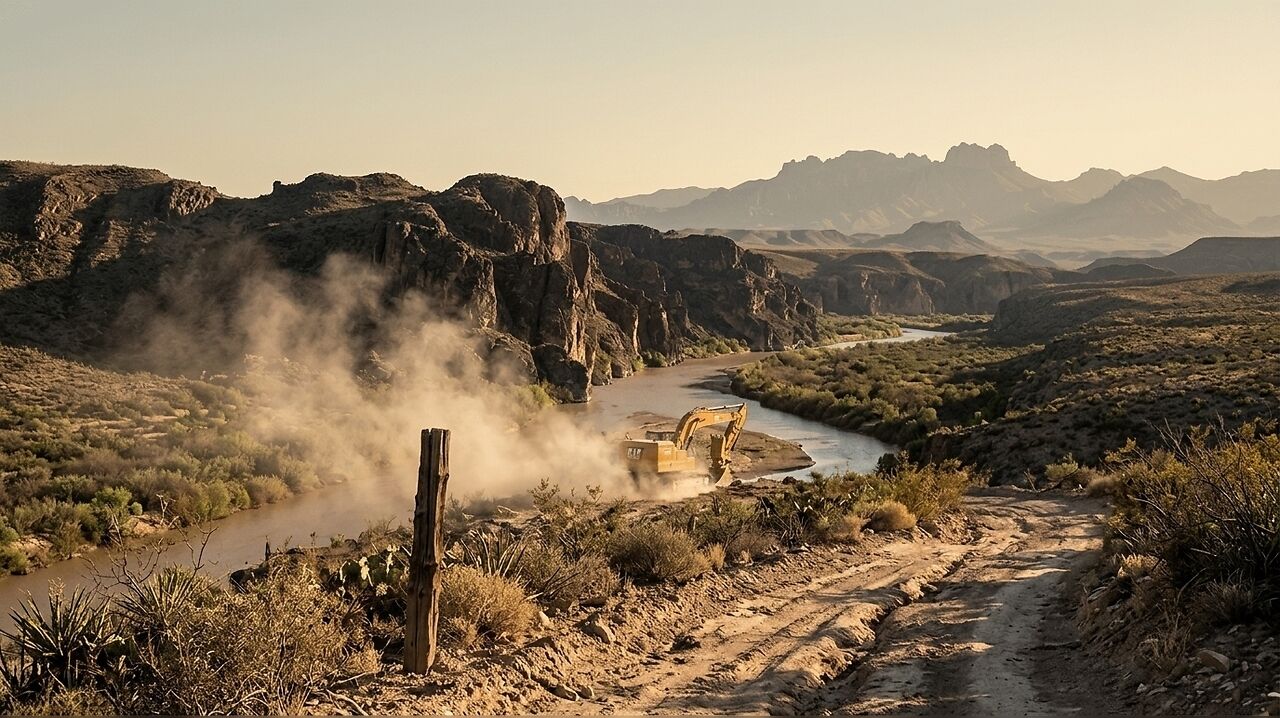
A federal judge has issued a preliminary injunction halting construction of border barriers in the Big Bend region of Texas, marking a significant development in an ongoing legal battle over federal infrastructure projects. US District Judge Kathleen Cardone ruled on Friday that the plaintiffs, which include local landowners and environmental advocates, demonstrated a likelihood of success on their constitutional claims challenging the government's construction plans.
The court order effectively prohibits “ground-disturbing activities” in the sector while the broader lawsuit proceeds. The legal challenge, initiated in April by the Center for Biological Diversity, represents a coalition of concerned citizens, including the Friends of the Ruidosa Church and local river guide Danny William Miller. The plaintiffs contend that the proposed border wall projects violate the separation of powers and threaten to deprive residents of their land rights and access to the Rio Grande.
Landowner Concerns and Environmental Impact
For residents of the Big Bend area, the dispute centers on the physical and economic consequences of the proposed infrastructure. During court proceedings, local landowners testified that the barriers would fundamentally alter the region’s landscape and restrict their ability to reach the river. Danny William Miller, who operates as a river guide, described the potential loss of river access as devastating to his livelihood, noting that the construction would transform the wilderness into a militarized zone.
Other residents, including Hudspeth County landowner Bill Guerra-Addington, echoed these concerns, testifying that the barriers would effectively destroy the utility of their properties. Attorneys for the plaintiffs argued that the harm caused by the construction extends beyond immediate environmental degradation, impacting the historic and cultural character of the region. The lawsuit documents the potential for irreversible damage to the desert ecosystem, which plaintiffs argue cannot be adequately restored once construction begins.
Government Rationale and Regional Context
The federal government maintains that physical barriers are essential for achieving operational control of the border. Officials have argued that such infrastructure is necessary to prevent unauthorized crossings and to protect sensitive areas, including Big Bend National Park, from potential cartel activity. Former Homeland Security Secretary Kristi Noem previously stated that while the current administration has secured the border, additional infrastructure is required to address evolving migration routes.
The Big Bend sector, which encompasses a vast stretch of the Texas-Mexico border, has historically accounted for a small percentage of total migrant apprehensions—typically between 1% and 3% annually. This statistical disparity has become a focal point for critics who question the necessity of the multi-billion-dollar project in such a remote area. Despite the ongoing legal challenges, the government has previously utilized waivers for the Endangered Species Act and the National Environmental Policy Act to expedite the construction of roads and barriers. With six separate lawsuits currently challenging the wall plans, the project remains a flashpoint for debate over federal authority and regional land rights.




