
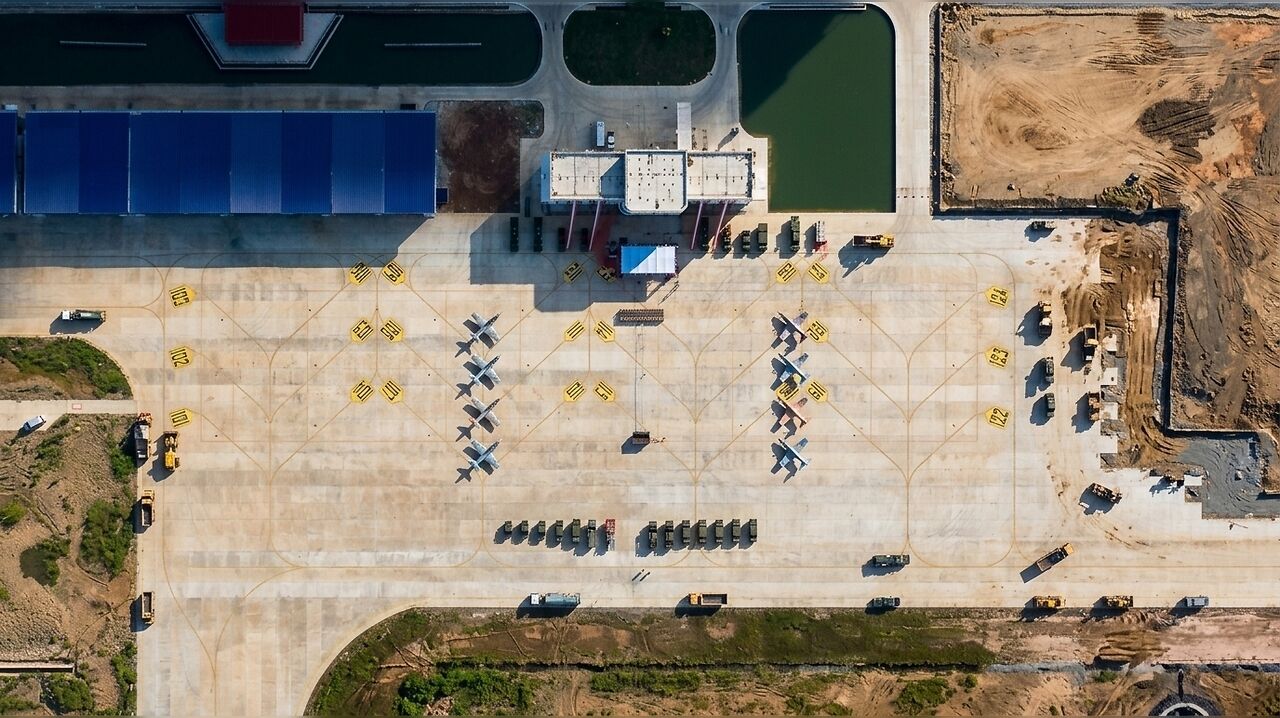
According to an official statement from China’s Ministry of Defence, the facility is intended to be jointly maintained by both nations. The development has drawn significant attention from regional security analysts and military observers, who are monitoring the site as a potential indicator of China’s growing military presence in mainland
Satellite Evidence and Operational Scope
Recent commercial satellite imagery captured by Vantor reveals ongoing construction at the site, including a runway expansion. The images show at least eight light attack aircraft and over two dozen support vehicles stationed at the base. Security analysts, including those from the S. Rajaratnam School of International Studies and the Pacific Forum, have identified the aircraft as Hongdu JL-8s, also known as K-8s. These two-seater planes are used by both Chinese and Lao forces for training and light attack missions.
While the current infrastructure appears focused on training, experts are observing the site for signs of further military integration. Analysts suggest that the airfield’s design may allow for future runway extensions to accommodate larger aircraft. Such upgrades could potentially support signals intelligence or electronic surveillance operations, which would extend China’s reach across the region. Observers are specifically looking for the installation of fuel storage, ammunition depots, and advanced air defence systems as markers of a more permanent or versatile military installation.
Historical Context and Strategic Positioning
The selection of Ban Keun carries historical significance, as the location was known as “Lima Site 44” during the 1970s. Records from the Library of Congress indicate that the site was used by Air America, a carrier covertly operated by the CIA, to transport American-backed Hmong forces and supplies during the conflict in Laos. The transition of the site from a Cold War-era American outpost to a Chinese-supported facility highlights the shifting geopolitical landscape in the region.
For China, the base represents a strategic foothold in mainland Southeast Asia, facilitated by existing infrastructure links such as the China-Laos railway. While Beijing has expanded its military footprint through port access in Cambodia and a logistics base in Djibouti, analysts suggest that the Ban Keun project serves as a target of opportunity to deepen its influence in the region. As construction continues, international observers remain focused on whether the facility will evolve beyond its current training mandate into a broader, fully fledged overseas




