
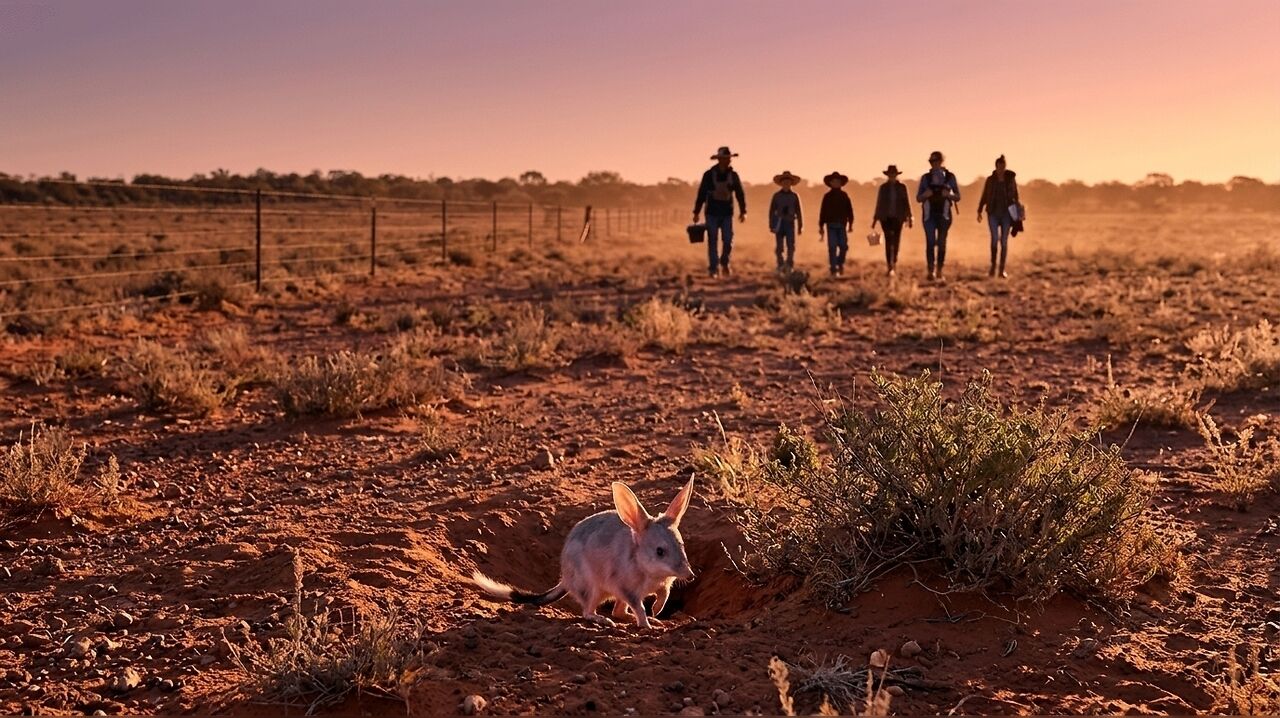
A decade-long conservation initiative in the remote outback of New South Wales has achieved a significant milestone in Australian ecological restoration. Ecologists Rebecca West and Reece Pedler, who relocated to the region in 2017, have successfully reintroduced six native mammal species to
The project, known as Wild Deserts, is a collaborative effort between the University of New South Wales (UNSW), the NSW National Parks and Wildlife Service, and the conservation group Ecological Horizons. By establishing 4,000 hectares of predator-proof enclosures and systematically removing invasive species such as rabbits, feral cats, and foxes, the team created a secure environment for native wildlife to return and thrive.
Restoring Ecological Balance in the Desert
The reintroduction process began in 2020, with the arrival of greater bilbies, crest-tailed mulgaras, and Shark Bay bandicoots. These were followed in 2022 by the introduction of golden bandicoots, western quolls, and burrowing bettongs. Beyond their status as iconic Australian species, these animals were selected for their critical roles as ecosystem engineers. Their natural digging habits facilitate soil turnover and improve water infiltration, which in turn supports the regeneration of native desert vegetation.
The success of the project is now extending beyond the initial fenced enclosures. To prepare the animals for life in the wider landscape, the team established a 100-square-kilometre Wild Training Zone where predator numbers are strictly managed. Recent data from September 2026 indicates that several species, including bilbies and bettongs, are not only surviving but are successfully breeding and establishing populations outside the primary protected areas.
A Long-Term Commitment to Wildlife Recovery
The progress observed at Sturt National Park has prompted a significant commitment to the future of the region. In June 2026, the NSW Government and UNSW announced a 10-year extension of their partnership, ensuring the continuation of predator management and population monitoring. This effort is particularly vital given that Australia has recorded some of the highest rates of mammal extinction globally since European settlement.
For the conservationists involved, the project represents a broader attempt to reconstruct a self-sustaining ecosystem. By focusing on the interplay between native fauna and the environment, the initiative aims to restore natural processes that had been absent for generations. As the project enters its next phase, the focus will shift toward scaling these successful reintroduction strategies across larger, more complex landscapes, marking a new chapter for biodiversity in the Australian outback.




