
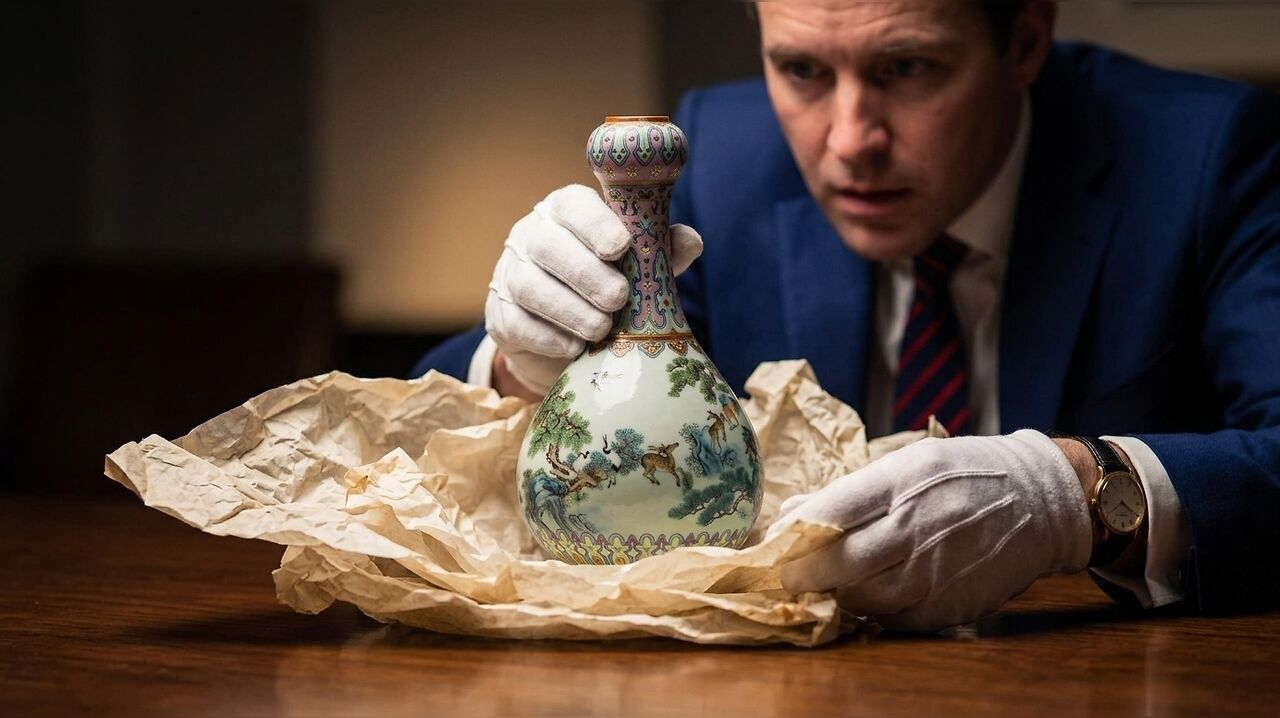
An unassuming porcelain vase, long relegated to a dusty attic in a French family home, has achieved a staggering €16.18 million at a Sotheby’s auction in Paris. The artifact, which the owners had previously dismissed as aesthetically unappealing, was identified by experts as a rare masterpiece commissioned for the court of the
The discovery occurred when a woman, who had inherited the piece from an uncle who passed away in 1947, contacted the auction house while clearing out her home. Unaware of the object's historical significance, she transported the delicate porcelain to Paris inside a simple shoebox, protected only by newspaper and a plastic bag. Despite the humble packaging, specialists at Sotheby’s immediately recognized the item as an exceptional example of imperial craftsmanship.
A Rare Imperial Discovery
The vase is categorized as a Famille-Rose, or yangcai, piece—a style of porcelain renowned for its intricate detail and complex production methods. The vessel features a detailed landscape depicting nine fallow deer, five cranes, pine trees, rocky mountains, and a waterfall. In Chinese artistic tradition, these elements are symbolic of health and longevity, and the scene is believed to represent an imperial pleasure garden.
Olivier Valmier, an Asian art specialist at Sotheby’s, noted the rarity of the find, comparing the significance of the discovery to unearthing a Caravaggio painting. The production of such porcelain was a highly specialized process, and because these items were manufactured in extremely limited quantities, the vast majority of surviving examples are currently housed in museum collections. The only known comparable piece, which features different decorative motifs, is held by the Musée Guimet in Paris.
Historical Records and Record-Breaking Sale
To verify the vase's origins, experts cross-referenced the piece with 18th-century imperial records. They identified entries for two pairs of vases matching the design, which were commissioned for the Qianlong Emperor in the 1760s—one set for a private Buddha Hall and another as a birthday gift. While the specific provenance of the family's vase prior to 1947 remains unclear, the records confirmed its status as a piece created for the imperial court.
The family’s collection, which also included a Japanese censer and a dragon robe, may have been acquired in the late 19th century, a period when Asian art gained significant popularity among European collectors. Records indicate that an ancestor of the family had purchased items at the 1867 Universal Exhibition in Paris, potentially providing a link to how the vase entered the family's possession.
When the vase went to auction on June 12, 2018, it shattered expectations. Although initially estimated at €700,000, a competitive 20-minute bidding war drove the final price to €16,182,800. At the time of the sale, this figure established a new record for




