
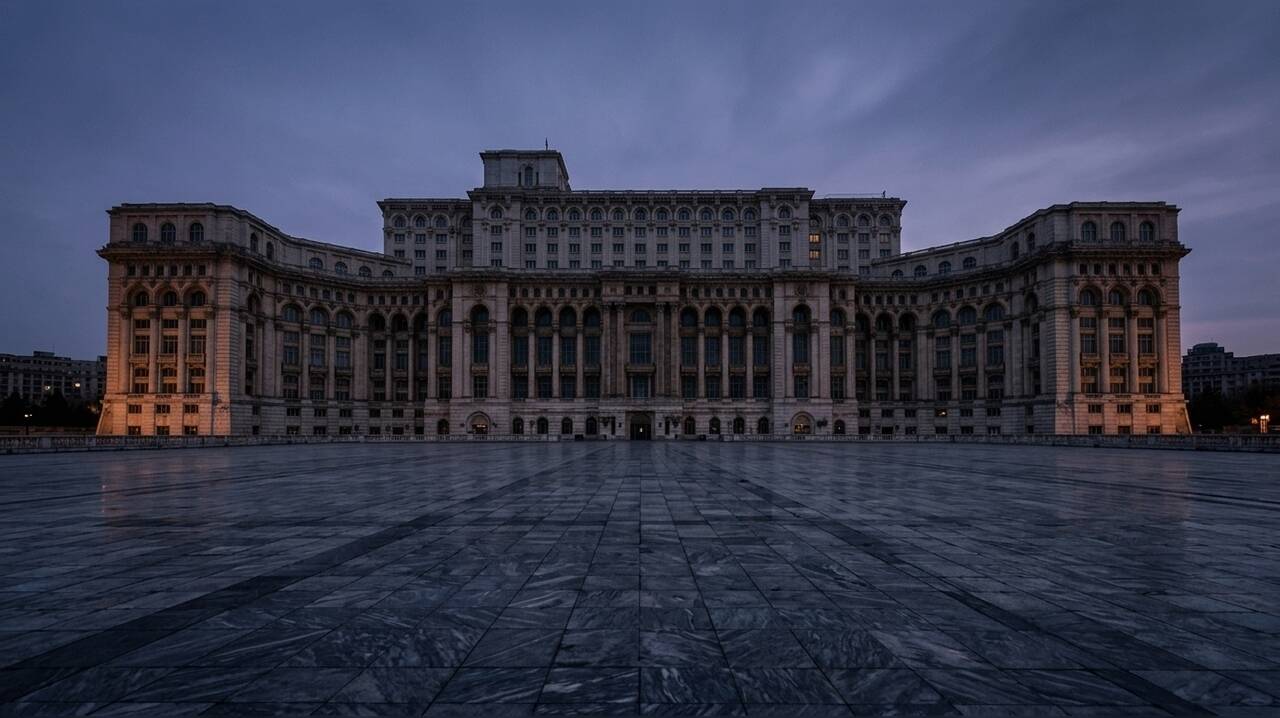
In the heart of Bucharest, the
The project was born from Ceaușescu’s desire to reshape Bucharest into a monument to his regime, a vision solidified following a devastating 1977 earthquake. Inspired by the monumental architecture he observed during visits to North Korea and China, the dictator sought to establish a new political and administrative center. This ambition necessitated the total transformation of the city’s historic landscape, leading to the destruction of the Uranus-Izvor district. To clear the site, approximately 10,000 homes were demolished, 20 churches were razed, and an estimated 57,000 families were forcibly relocated.
A Monumental Construction Effort
Construction of the palace began in 1984, overseen by chief architect Anca Petrescu, who was only 28 years old when she won the design competition. She led a massive team of roughly 700 architects, while the labor force was equally staggering. Official records from the Romanian Parliament indicate that more than 100,000 people contributed to the project. At the height of activity, nearly 20,000 workers operated in three shifts to maintain 24-hour progress, supported by 12,000 soldiers between 1984 and 1990.
The materials required for the build were vast, sourced almost entirely from within Romania. The structure incorporates one million cubic meters of marble, 700,000 tonnes of steel, 550,000 tonnes of cement, and 3,500 tonnes of crystal. Spanning 365,000 square meters, the building reaches 84 meters above ground, with an additional 16 meters extending into the earth. Despite its immense size, the palace contains approximately 1,100 rooms, a significant portion of which remain underutilized to this day.
A Shifting Legacy
Ceaușescu never witnessed the completion of his vision. When the Romanian Revolution occurred in December 1989, the palace was only about 60% finished. Following the execution of the dictator and his wife, Elena, on December 25, 1989, the new Romanian state inherited the unfinished site. Construction continued at a reduced pace until the building was finally completed in 1997. It now serves as the seat of the country’s Chamber of Deputies and Senate.
Beyond its historical significance, the palace is notable for its physical impact on the ground beneath it. Due to its extraordinary weight, the structure is reportedly sinking at a rate of approximately 6 millimeters per year as the underlying sediment settles. While this movement does not pose an immediate threat, it serves as a persistent reminder of the building’s massive footprint. Decades after the fall of the communist regime, the palace remains a central, albeit partly empty, fixture of Bucharest, symbolizing a period of radical urban transformation.




