
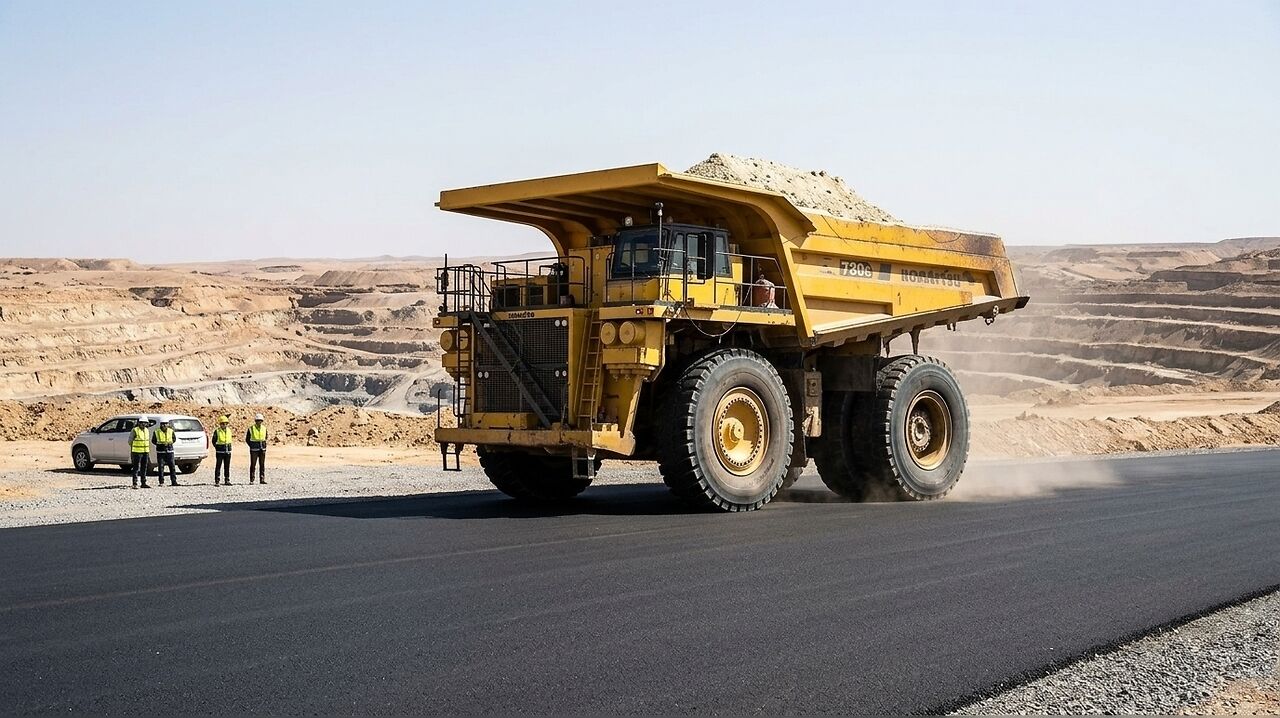
A recent study conducted at the Benguerir phosphate mine in
The project, detailed in the journal Mining, focused on creating a sustainable and cost-effective solution for the mine's haul roads, which handle approximately 22.35 kilotonnes of material daily. The experimental pavement structure consists of a 0.35-metre sub-base of crushed waste rock, a 0.25-metre base layer of screening waste, and a 0.07-metre asphalt wearing course composed of phosphated flint aggregates and modified bitumen.
Performance and Environmental Impact
Laboratory and field assessments confirmed that the new pavement design meets the rigorous mechanical demands of mining operations. Testing of the asphalt mixture identified an optimal bitumen content of 5.1%, which provided a stiffness modulus of 9160 MPa and demonstrated strong resistance to structural rutting and deformation. Subsequent field measurements of the compacted layers showed high load-bearing capacities, with the sub-base and base layers recording average EV2 values of 153 MPa and 181 MPa, respectively.
The most significant environmental finding was the substantial decrease in airborne particulate matter. Before the installation of the pavement, the mine relied on daily watering and grading, yet recorded average dust concentrations of 91,730.16 micrograms per cubic metre. Following the implementation of the new surface, dust levels dropped to 8570.10 micrograms per cubic metre. This 91% reduction surpassed the OCP Group's initial target of an 80% decrease in airborne dust emissions.
Operational Efficiency and Economic Viability
Beyond environmental benefits, the study highlights potential gains in mining productivity. The construction of the pavement was estimated at approximately €23.97 per square metre, assuming proximity to crushing and asphalt facilities. Internal assessments conducted by OCP after 15 months of continuous operation suggest that broader implementation could lead to an annual productivity increase of roughly 15%.
These gains are attributed to several operational improvements, including higher average truck speeds, reduced surface roughness, and enhanced visibility for operators. Furthermore, the stability of the new road surface is expected to lower maintenance requirements, extend the service life of the mining fleet, and decrease the frequency of spare-part replacements for critical components such as tyres and wheel motors.




