
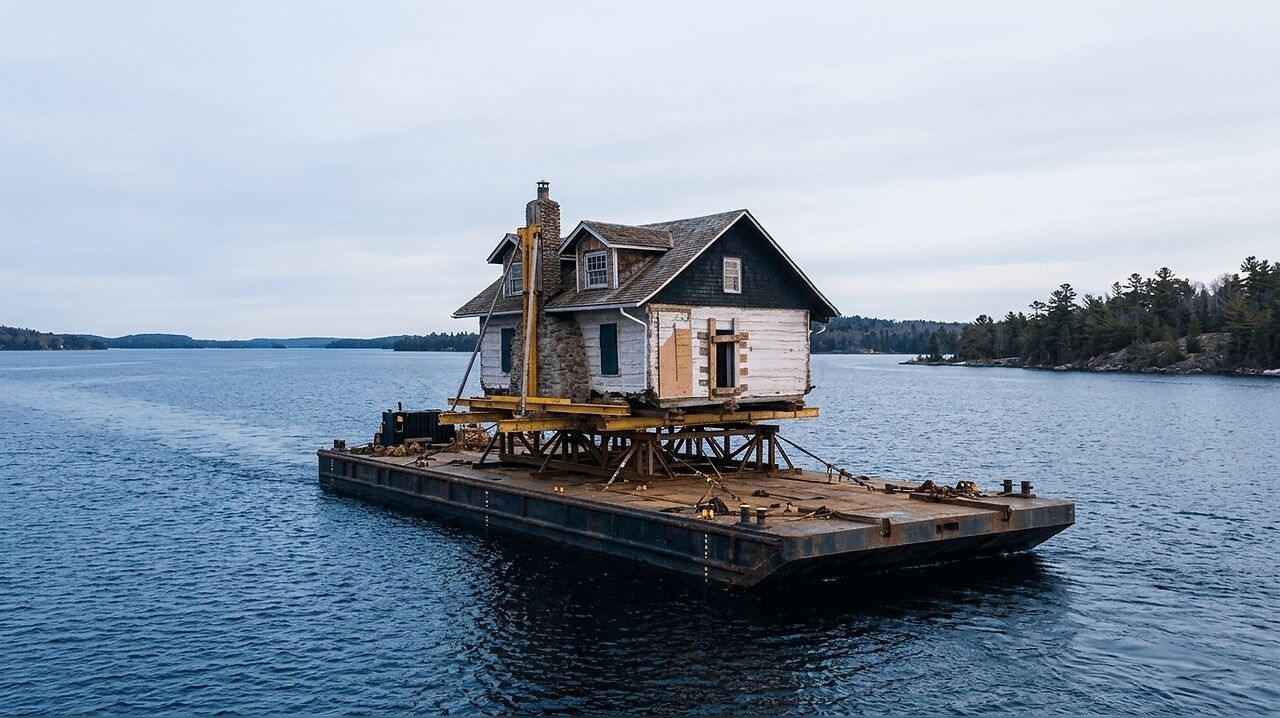
A significant piece of Canadian history has completed a precarious journey across the waters of Georgian Bay. The
The relocation of the 75,000-pound structure was a complex logistical operation. To ensure the safety of the historic building, crews utilized hydraulic jacks and steel beams to lift the house from its foundation before securing it onto a heavy-duty transport trailer. The building was then loaded onto a barge, which navigated the open waters of the bay. Throughout the transit, teams monitored weather conditions closely, as high winds and choppy waves posed a significant risk to the stability of the cargo. The house arrived safely at its destination, where it currently rests on a temporary support frame.
Preserving a Rare Cultural Landmark
The decision to relocate the house stemmed from the constraints of its original private property, which lacked the necessary infrastructure to accommodate public access or long-term conservation efforts. In a gesture to ensure the home's survival, the private owner sold the building to the Métis Nation of Ontario for a symbolic sum of $2. The new site, a 39-acre property on Balm Beach Road East, provides ample space for the development of a museum and cultural centre, including planned walking trails and educational facilities.
For the Métis community, the preservation of the Labatte House represents more than the maintenance of an architectural relic. Mitch Anderson, a representative for the project, described the structure as a vital piece of living history that serves as evidence of the enduring presence of the Métis people in Ontario. The site is intended to function as a cultural haven, offering a space to showcase 19th-century trade tools, household artifacts, and historical documents that chronicle the community's early life around the Great Lakes.
Future Restoration and Heritage Status
While the house has reached its new home, the project is far from complete. Restoration teams are preparing to pour a permanent concrete foundation in the spring of 2027. Following this, the focus will shift to extensive repairs on the building's timber frame, roof, and interior stonework. These efforts are expected to continue over the coming months as the site is prepared for its future role as a public museum.
Once the house is securely positioned on its permanent foundation, the Métis Nation of Ontario intends to seek official municipal heritage designation from the Township of Tiny. This legal status would provide formal protection against future demolition or structural alterations. As the project progresses, the arrival of the house has already drawn support from the local community and descendants of the Labatte family, who gathered to mark the successful completion of the building's journey.




