
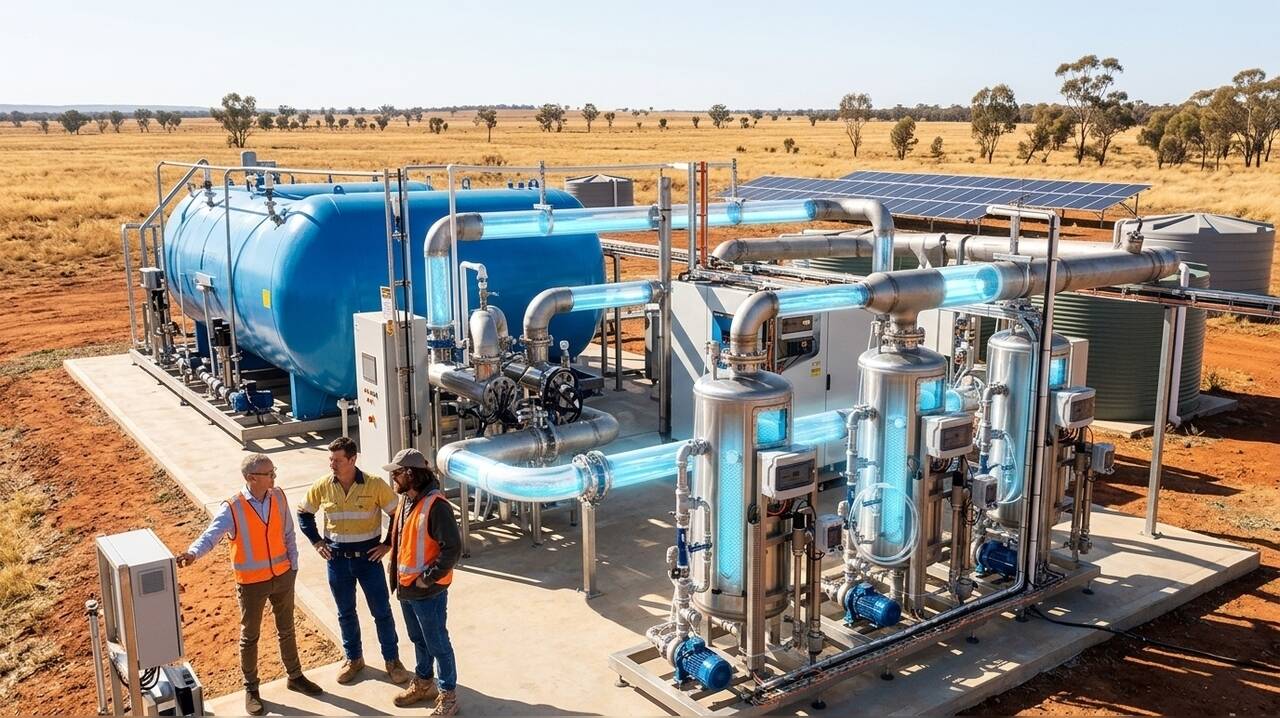
A new advanced wastewater treatment facility has officially commenced operations in Dubbo, New South Wales, marking a significant step in regional efforts to bolster water security. The $7.8 million project is designed to process up to 700 megalitres of sewage effluent annually, a volume equivalent to approximately 280 Olympic-sized swimming pools.
The facility, which was launched this week, is the result of a public-private partnership between the Dubbo Regional Council and the renewable energy firm
Innovative Technology for Pollutant Removal
At the core of the facility is a specialized treatment system developed by water scientist Troy Warry. The technology employs a titanium-dioxide-based catalyst that is permanently fixed within the reactor and activated by light. Unlike traditional filtration methods that merely separate contaminants, this system is engineered to chemically break down persistent pollutants, including pharmaceutical residues, pesticides, hormones, and petroleum hydrocarbons.
According to the developer, this method is approximately 16 times more efficient than conventional advanced oxidation processes. While the technology has previously undergone trials in Germany, Spain, and Norway, experts suggest that its performance at this scale requires further evaluation. Stuart Khan, a professor of civil engineering at the University of Sydney, noted that while the approach is distinct, its broader impact will depend on ongoing performance assessments.
Strategic Water Management and Future Applications
The facility was constructed adjacent to Dubbo’s existing sewerage infrastructure. Squadron Energy provided $3.6 million in funding for the project, securing access to recycled water for its regional renewable energy construction activities. Both the council and the energy firm have stated that the infrastructure is intended to serve as a long-term water security asset for the wider community.
Currently, the recycled water is undergoing a phased approval process. Dubbo Regional Council is working to secure permits for uses such as dust suppression and concrete batching. Additionally, the council is collaborating with the University of Newcastle to conduct further testing, which could eventually allow the recycled water to be used for the irrigation of local sporting facilities.
For inland communities, this technology offers a potential alternative to membrane-based systems like reverse osmosis. Professor Khan observed that while reverse osmosis is effective, it often leaves behind concentrated salty waste, which presents significant disposal challenges for inland regions. By focusing on chemical breakdown rather than filtration, the Dubbo project aims to provide a sustainable model for converting wastewater into a reliable supplement for regional water supplies.




