
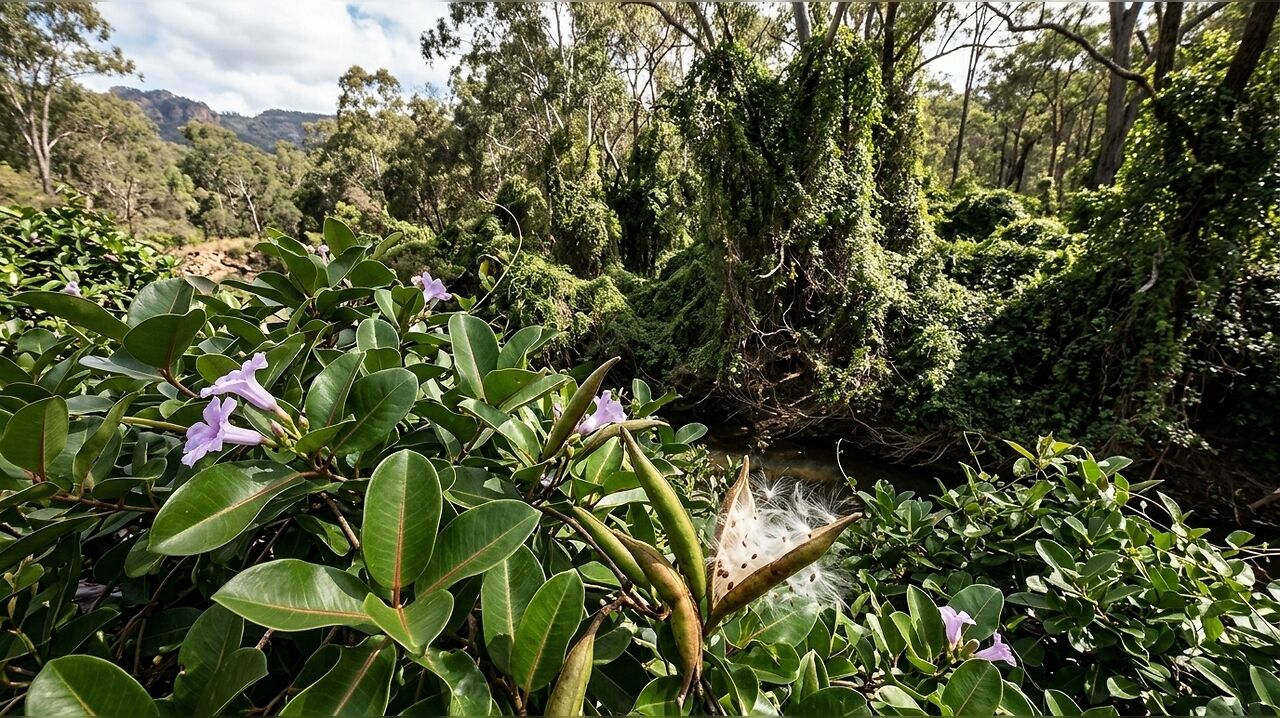
Introduced to Australia from Madagascar in the 1860s as a garden ornamental, the rubber vine has evolved into one of the country’s most persistent and damaging invasive species. The woody climber, which can reach heights of up to 30 metres when supported by tree canopies, has spread extensively across Queensland and into parts of New South Wales, creating dense thickets that smother native vegetation and disrupt local ecosystems.
Beyond its ecological impact, the plant poses significant risks to agriculture and human health. It is highly toxic to livestock, containing cardiac glycosides that can cause fatal heart failure in cattle, horses, and sheep. Furthermore, the plant’s milky sap is a known skin irritant, and its presence complicates land management, particularly in pastoral regions where it creates physical barriers that impede the mustering of livestock.
A History of Proliferation and Environmental Impact
The rubber vine’s journey from a decorative garden plant to a widespread weed was accelerated during the Second World War, when it was cultivated as a potential source of rubber. Its ability to thrive in diverse environments—ranging from semi-arid regions to tropical riverbanks—has allowed it to colonize vast areas, including the Gulf of Carpentaria and coastal zones as far south as Bundaberg. In 1991, a single infestation in Queensland was estimated to cover 700,000 hectares, illustrating the scale of the challenge faced by land managers.
The plant is characterized by its glossy, opposite-paired leaves and showy, trumpet-shaped flowers, which can bloom throughout the year given sufficient moisture. Its most distinctive feature, however, is its rigid, paired seed pods. Each pod can contain hundreds of seeds equipped with silky hairs, allowing them to be dispersed easily by wind and water. Once established, the plant is notoriously difficult to eradicate, as its root system can penetrate up to 12 metres into the soil.
Management, Regulation, and Biosecurity
Controlling the spread of rubber vine requires a multifaceted approach. In Queensland, where the plant is classified as a category 3 restricted invasive species, management strategies include controlled burning, mechanical slashing, and the targeted application of herbicides. Biological control agents, such as a specific rust fungus and a leaf-feeding moth, have also been introduced to help suppress the plant's growth and seed production, though these methods rarely result in the total destruction of established vines.
Regulatory requirements differ by state. In New South Wales, where the plant is designated as prohibited matter, authorities emphasize containment and eradication. The New South Wales Department of Primary Industries advises residents not to attempt removal themselves, but rather to report sightings immediately to the state’s biosecurity helpline. Similarly, in Queensland, landholders are legally obligated to take reasonable steps to minimize the biosecurity risks posed by the plant on their properties. Authorities urge the public to remain vigilant, as the plant’s toxicity and rapid growth continue to present ongoing challenges for both environmental conservation and the agricultural sector.




