
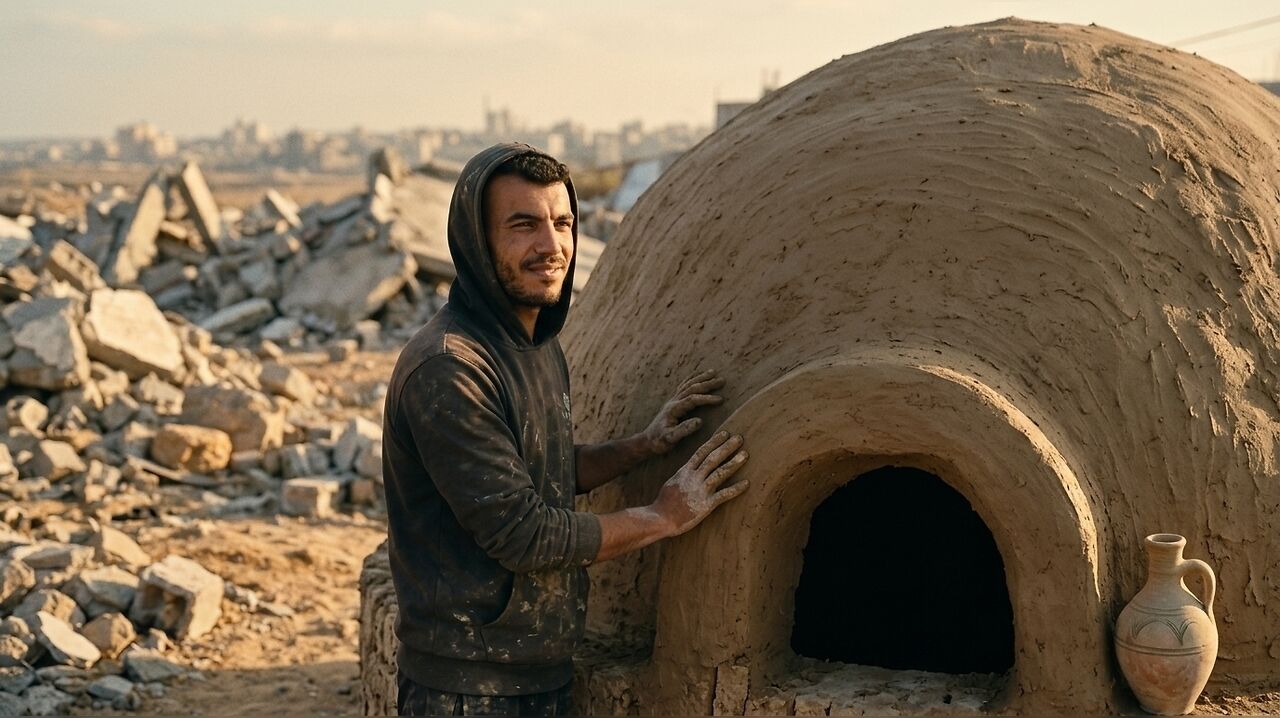
After spending two years living in a tent, Palestinian potter
The structure draws inspiration from the traditional bread ovens the family has crafted for generations. By experimenting with various mixtures and developing a waterproof glaze, Atallah created a dwelling that is significantly more durable than standard temporary shelters. He noted that the clay construction provides essential protection against the elements, allowing for the storage of food that would otherwise spoil in the intense summer heat of a tent. Following the success of his parents' home, Atallah has begun building a similar structure for himself and his wife, sharing his techniques online to encourage others to adopt the method.
Innovation Amidst a Construction Material Crisis
Atallah’s initiative highlights the desperate measures residents are taking to secure housing in an environment where conventional building materials are largely inaccessible. According to the United Nations Office for the Coordination of Humanitarian Affairs, Israel has strictly limited the entry of items such as cement and steel, classifying them as dual-use materials. Israeli authorities maintain that these restrictions are necessary to prevent the diversion of resources by Hamas for military purposes, including the construction of tunnels. This policy has created a profound bottleneck for humanitarian efforts and private reconstruction, leaving an estimated 1.9 million displaced people in Gaza without adequate housing.
The scarcity of materials has spurred a wave of grassroots innovation. Beyond Atallah’s clay domes, other residents are attempting to repurpose the vast quantities of rubble left by the conflict. Teenage sisters Tala and Farah Moussa have developed a method for creating bricks from crushed concrete debris, ash, and glass. Their innovation, which earned a youth award from the Swiss-based Earth Foundation, is intended for use in partitions and pavements. While these efforts provide a degree of relief, experts like Iyad Abu Hamam of the Norwegian Refugee Council caution that recycled materials often lack the structural integrity required for safe, long-term housing, particularly for roofing and load-bearing applications.
The Limits of Local Resourcefulness
While the use of clay and rubble offers a creative response to the current housing crisis, these methods are not a substitute for large-scale, professional reconstruction. Even with local materials, the process remains labour-intensive and costly within the constraints of Gaza’s wartime economy. Furthermore, there is no consensus on the long-term safety or weather resistance of these improvised structures compared to standard building codes.
The broader reality for many in Gaza remains one of uncertainty and displacement. Even as families attempt to restore their livelihoods and establish makeshift routines, the lack of basic infrastructure and the ongoing restrictions on imports continue to hinder recovery. For individuals like Atallah, the use of traditional skills to build homes is a necessary adaptation to an environment where waiting for conventional supplies is no longer a viable option. However, the fundamental challenge of rebuilding the territory remains tied to the broader geopolitical dispute over access to essential construction resources and the restoration of basic services.




