
As Europe accelerates its transition to
The Swedish energy company
Innovative Repurposing of Turbine Components
The durability that allows wind turbines to operate for up to 25 years in harsh conditions is precisely what makes their blades difficult to process. Composed of complex layers of glass fibre, carbon fibre, epoxy resin, and balsa wood, these materials require energy-intensive treatment to separate. To bypass these challenges, Vattenfall has collaborated with design partners to explore creative reuse.
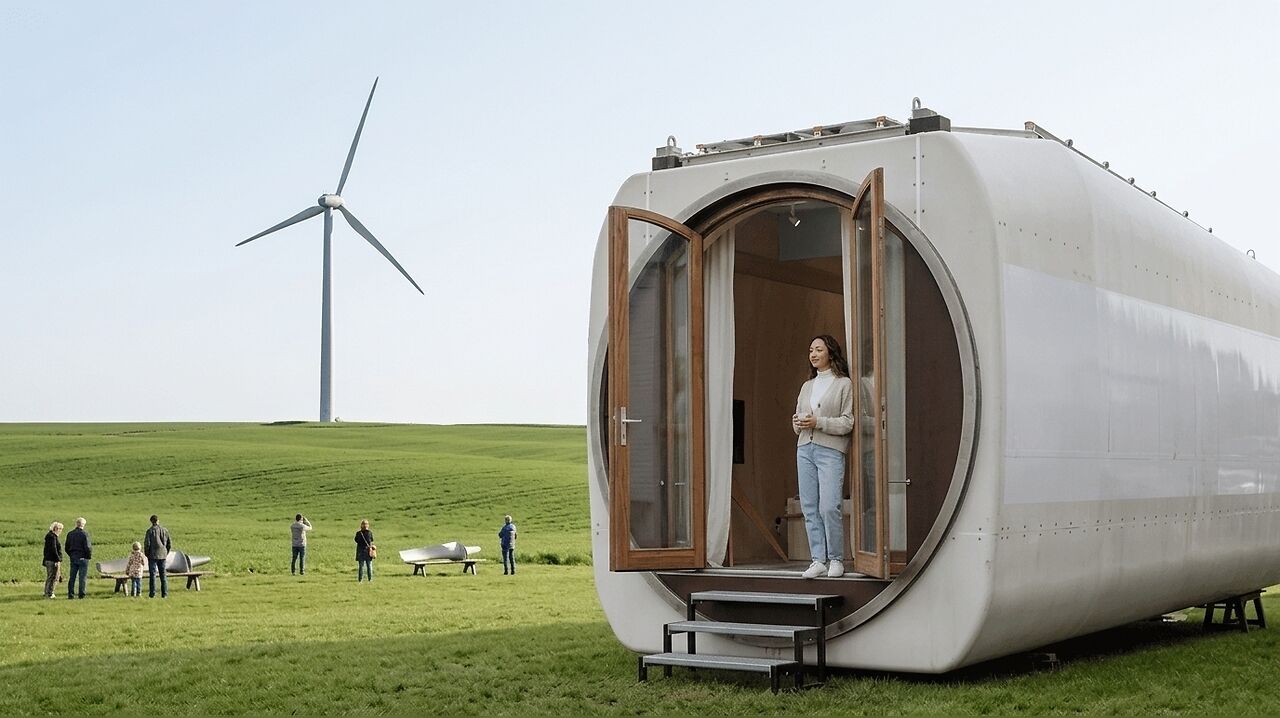
One notable project involves a retired nacelle cover—the protective housing for a turbine’s mechanical equipment—which was converted into a compact, solar-powered tiny house. Measuring four metres by ten metres, the structure was outfitted with a kitchen, bathroom, and living area, and was featured at the 2024 Dutch Design Week. Similarly, 57 blades from a Danish wind farm were repurposed as a facade for a multi-storey car park in Lund, demonstrating the potential for using decommissioned blades as structural building materials.
Scaling Circular Solutions for the Future
Beyond architectural applications, the industry is experimenting with smaller-scale recycling, including the production of alpine skis from blade materials. Eva Julius-Philipp, Director of Environment and Sustainability of Business Area Wind at Vattenfall, noted that while these projects are not yet large-scale solutions, they are essential for stimulating the market for circular products and developing new applications for composite waste.
Currently, Vattenfall employs mechanical recycling to convert blade material into fillers for new products, alongside pyrolysis, a thermal process that recovers fibres. The company has set a goal to achieve 100 percent circularity for these materials by 2030. However, the regulatory landscape remains fragmented. While countries such as Austria, Finland, Germany, and the Netherlands have implemented national bans on landfilling turbine blades, there is no EU-wide mandate. Industry advocates are now looking toward the European Commission’s forthcoming




