
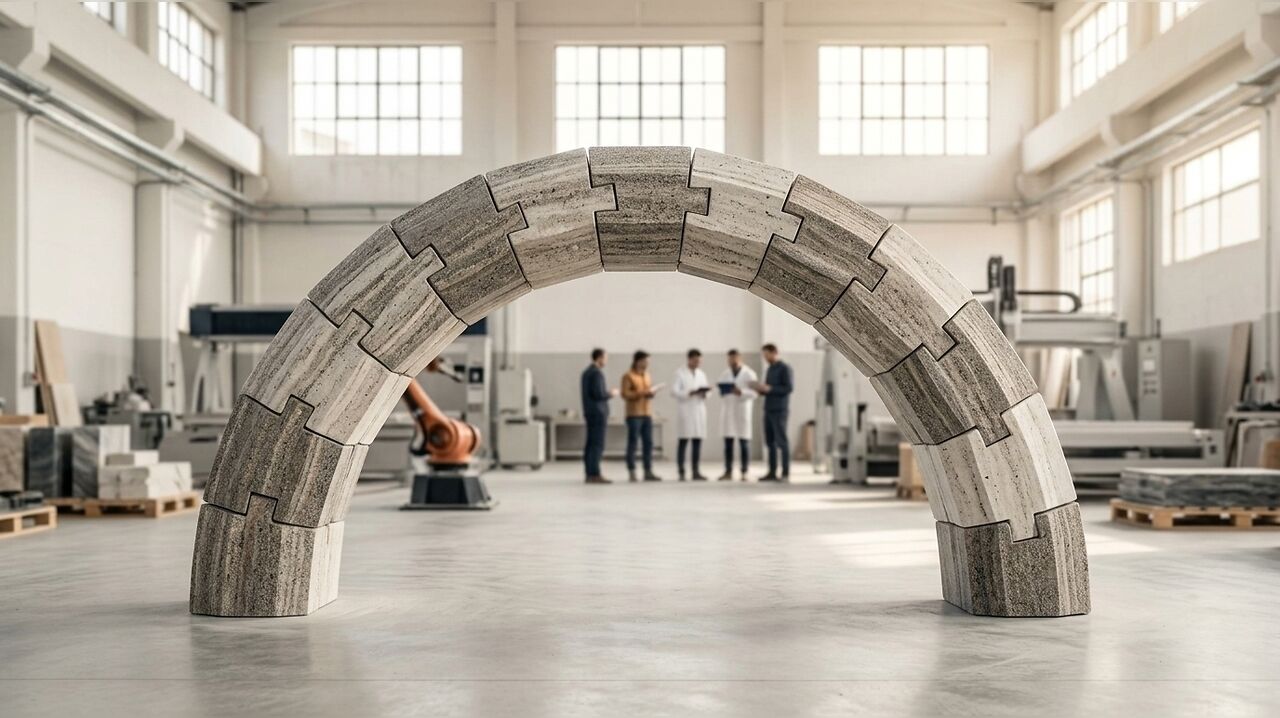
A team of researchers and engineers has successfully brought a 500-year-old architectural vision to life, constructing a 3D-printed pedestrian bridge based on a design originally sketched by
Conceived by Professor Giuseppe Fallacara of the
Sustainable Innovation in Construction
The project distinguishes itself through its commitment to environmental sustainability, specifically by repurposing industrial byproducts. The construction material is a specialized mortar developed by the Italian start-up B&Y, led by Vincenzo Gurrado. This mixture incorporates 30% waste stone and marble powder, bound together with a lime-based agent to create a low-impact building medium.
The collaboration involved the ArCoD department at the Polytechnic University of Bari, which oversaw the design, and the technology firm WASP, which provided the large-format 3D-printing equipment. By utilizing the WASP 3MT LDM Concrete printer, the team produced 13 individual blocks that form the bridge’s structure. This approach highlights a potential path forward for the construction industry, suggesting that waste generated during stone processing can be effectively integrated into high-tech manufacturing rather than discarded.
Stereotomy and Structural Integrity
Central to the bridge's stability is the principle of stereotomy, an ancient technique involving the precise cutting and arrangement of structural elements to create a self-supporting form. Da Vinci’s original design relied on this geometric logic to ensure the bridge could stand without the need for complex internal reinforcements. The research team applied this same principle to the 13 printed blocks, which were assembled using a temporary centering system that was removed once the structure was complete.
The finished prototype stands independently, proving that the combination of historical design theory and modern additive manufacturing is viable for structural applications. As of January 2025, the research team is focused on further evaluating the mechanical properties of the stone-waste mortar and refining the printing process for future use. This experiment marks a significant intersection between historical engineering concepts and the evolving capabilities of 3D-printed infrastructure.




