
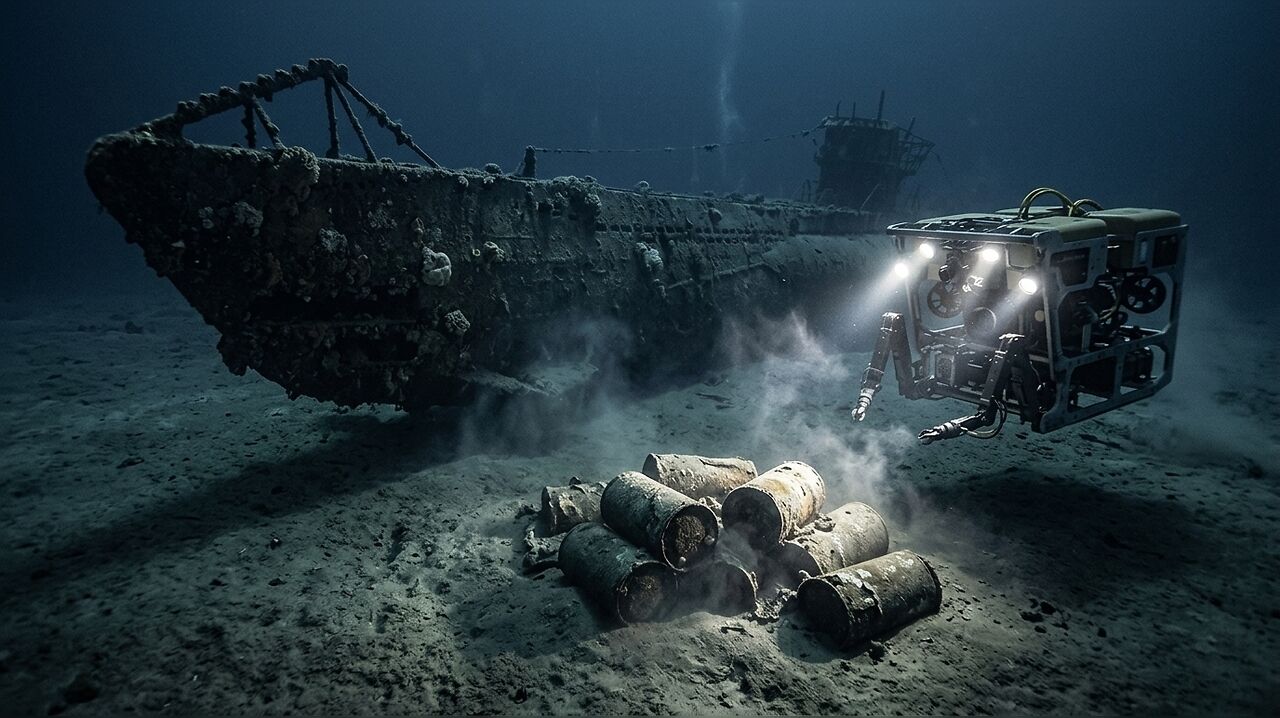
More than eight decades after the British submarine HMS Venturer sank the German U-boat
In June 2026, Norwegian authorities successfully retrieved 22 mercury containers from the wreck, which lies approximately 150 metres below the surface near Fedje island. The recovery operation, conducted by the Norwegian Coastal Administration (
A Legacy of Wartime Logistics and Environmental Risk
The U-864 was a German Type IXD2 submarine engaged in Operation Caesar, a mission intended to transport military equipment and industrial materials to Japan during the final months of World War II. While historical records from the British archives suggest the vessel may have been carrying as many as 1,867 containers of mercury—potentially totaling up to 67 tonnes—the exact amount on board remains unconfirmed due to the absence of original loading manifests. The encounter between the two submarines remains a notable event in naval history, as it is the only recorded instance of one submerged submarine sinking another.
Since the wreck was discovered in 2003, it has been identified as a persistent source of pollution. Norwegian government data indicates that an area of approximately 47,000 square metres surrounding the site is contaminated, with an estimated four kilograms of mercury leaking into the environment annually. Because mercury can transform into methylmercury and accumulate in the food chain, authorities have maintained long-standing dietary restrictions on seafood caught in the vicinity of the wreck, particularly for vulnerable groups including children and pregnant women.
The Challenge of Remediation
Following a series of surveys conducted between 2025 and 2026, Kystverket evaluated the feasibility of removing the remaining cargo. While the use of remotely operated underwater vehicles proved that the containers could be reached, the operation also demonstrated the inherent dangers of intervention. The process of extracting the damaged containers risks disturbing the contaminated seabed and causing a further, more immediate release of mercury into the water.
In a report submitted in September 2026, the agency concluded that while recovery is technically possible, it is both significantly more expensive and environmentally riskier than alternative solutions. Kystverket has formally recommended that the most effective way to mitigate long-term damage is to permanently cover the wreck and the surrounding contaminated sediment. This proposal is currently under review by the Norwegian Ministry of Trade, Industry and Fisheries, which will determine the final strategy for securing the site.




