
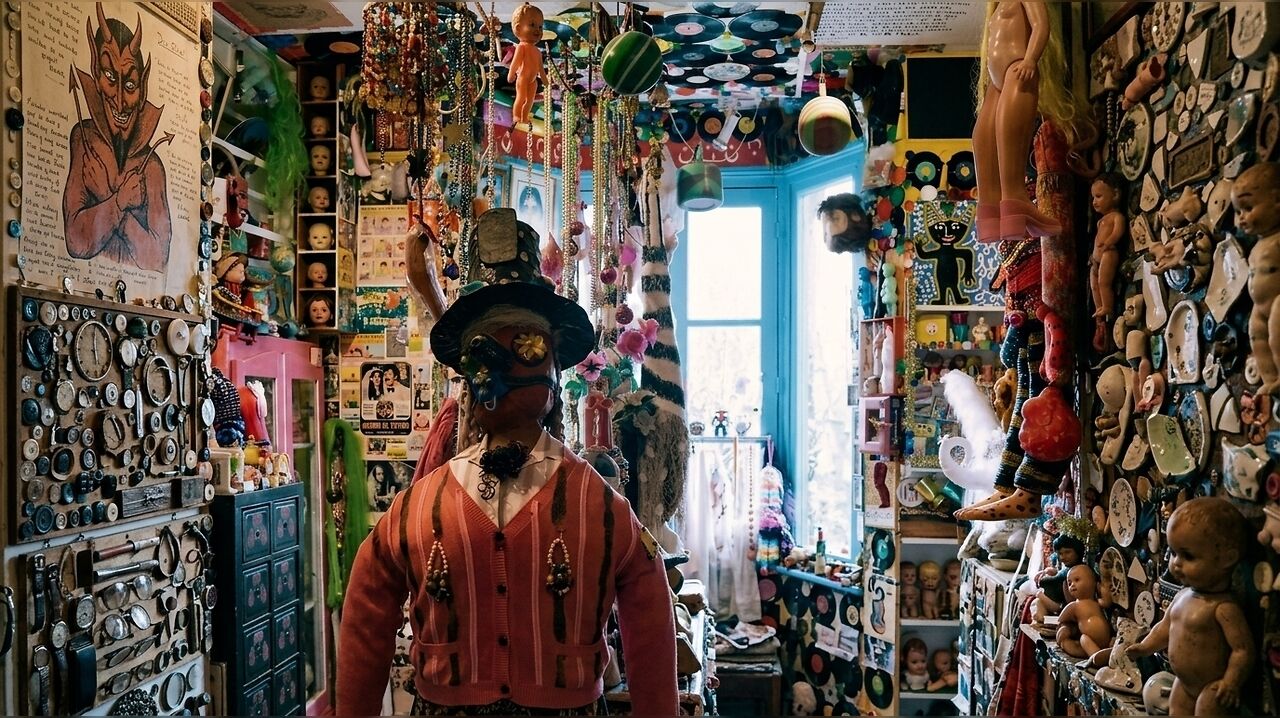
In a quiet corner of East Dulwich, London, a residential property has been transformed into an expansive, immersive art environment known as the
The project, which officially commenced in 1998, was initially inspired by the television series Journeys into the Outside, hosted by Jarvis Cocker. This introduction to the world of outsider art environments prompted Wright to seek a more permanent form of creative expression. Having previously worked in the fashion and stationery industries, Wright sought to move away from the transient nature of commercial design, where products are frequently used and discarded. By repurposing everyday items, he aimed to create a lasting work that would provide a new, meaningful existence for objects that others had abandoned.
A Repository of Personal History and Found Art
The House of Dreams is defined by its dense, mosaic-like aesthetic, where items such as broken dolls, false teeth, vintage glasses, and ceramic shards are stitched, glued, or embedded into the structure of the building. Many of these pieces were sourced during Wright’s travels to cities including Paris, Madrid, Prague, and Budapest. Rather than serving as mere decoration, these objects are often incorporated into shrines or sculptures, each carrying its own specific history or connection to the artist’s personal narrative.
The collection is profoundly shaped by the artist’s experiences with grief and memory. Following the deaths of his parents and his former partner, Donald Jones—with whom he had visited similar artistic sites in France—Wright found that the project became a therapeutic outlet. The house serves as a physical diary, featuring handwritten memory boards that document overheard conversations, political observations, and reflections on life. Personal artifacts, such as a small purse belonging to his mother or a toy lion unearthed from his childhood garden, are integrated into the displays, grounding the abstract art in tangible family history.
The Future of the House of Dreams
Today, the museum remains an active, unfinished work. Wright continues to add to the collection, incorporating everything from donated items to objects found in the street, such as a ponytail donated by actor Richard Ashton in 2016. The artist views the space as a sanctuary for the discarded and unwanted, reflecting themes of trauma, joy, and the passage of time. He has explicitly stated that he does not always follow a rigid plan, focusing instead on the continuous act of creation.
Looking toward the future, the House of Dreams is intended to persist beyond the life of its creator. Wright has confirmed that he has bequeathed the property and its contents to the




