
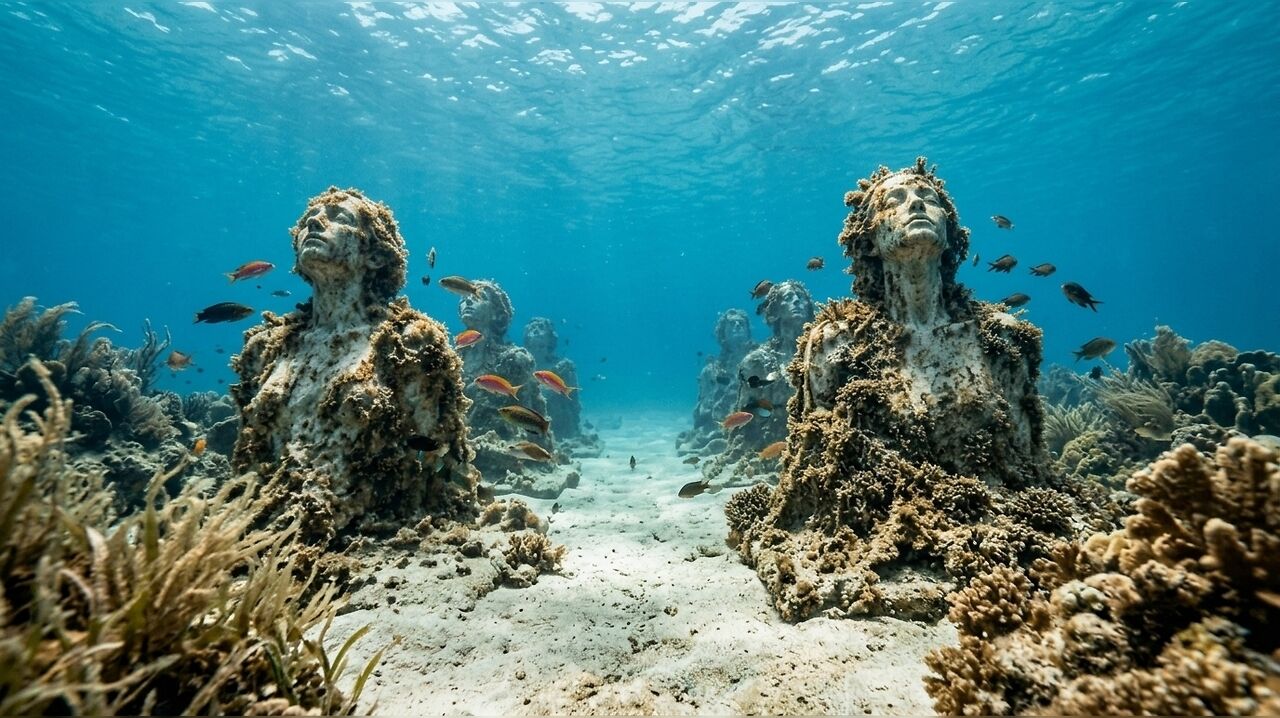
A series of monumental marble sculptures submerged off the coast of Tuscany have begun to function as vital artificial reefs, according to a new scientific assessment. The five statues, located in the Baia del Cannone near Talamone, were placed on the seabed in September 2024 as part of a conservation initiative led by the non-profit association
The study, published in the journal MDPI, marks the first systematic attempt to quantify the ecological impact of using art-based structures to enhance habitat heterogeneity in the Mediterranean. While the sculptures were primarily designed to support conservation outreach and discourage illegal bottom trawling, the findings indicate they are actively supporting the development of early trophic relationships and providing essential shelter for various marine organisms.
Ecological Colonisation and Habitat Development
The research team conducted periodic surveys between September 2024 and October 2025, documenting the gradual colonisation of the 12-tonne marble blocks. The study highlights a clear distinction in how marine life interacts with different parts of the sculptures. Exposed surfaces saw a rapid increase in species diversity, with organisms such as the brown alga Padina pavonica and the sea urchin Arbacia lixula becoming increasingly frequent. By October 2025, one sculpture alone supported 15 different taxa, up from just four at the start of the monitoring period.
In contrast, the undersides of the sculptures, which provide shaded cavities, developed more slowly. These areas became increasingly important as refuge habitats, particularly for the cardinalfish Apogon imberbis and the sea cucumber Holothuria poli. Researchers noted that the divergence between the exposed surfaces and the sheltered undersides became more pronounced as the project progressed, suggesting that the structures are successfully creating diverse microhabitats that cater to different biological needs.
Impact on Local Fish Assemblages
While the sculptures have fostered significant growth on their own surfaces, their impact on the surrounding environment remains nuanced. The study found that while the composition of fish assemblages in the immediate vicinity shifted over the course of the year—with species such as the rainbow wrasse and common two-banded seabream becoming more prevalent—the overall benthic cover of the surrounding seabed showed limited change.
The authors of the study described the project as a pilot-scale assessment and cautioned that longer-term monitoring is necessary to fully understand the ecological trajectory of the site. They noted that artificial reefs can sometimes present trade-offs, such as the potential facilitation of non-indigenous species. Despite these limitations, the research concludes that the marble installations are effectively acting as small, functional reef units that increase habitat complexity in soft-bottom coastal environments, offering a promising model for future marine conservation efforts.




