
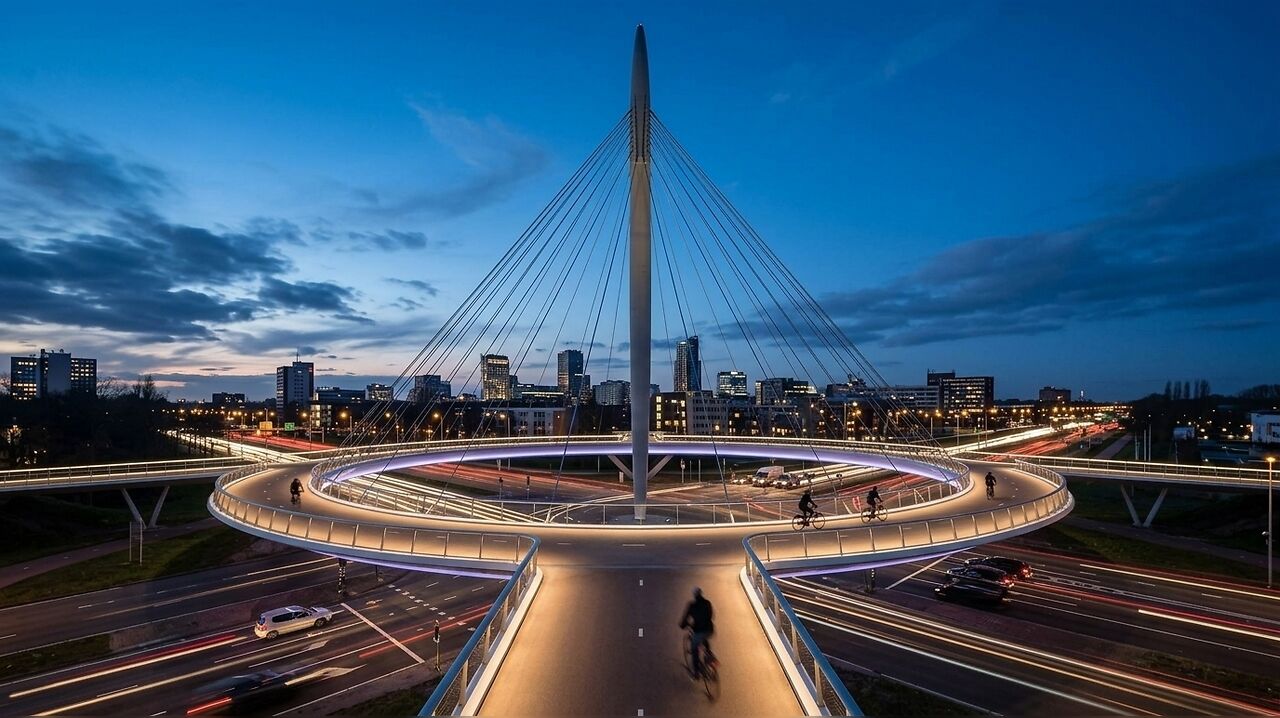
In the Dutch city of
The development of the Hovenring was driven by the need to manage increasing traffic volumes, particularly following the construction of a nearby housing estate. City planners sought an alternative to traditional underpasses or ground-level roundabouts, which were deemed inadequate for the growing number of cyclists. By elevating the cycle path, the design allows motor vehicles to continue moving through the intersection below, while cyclists and pedestrians navigate the circular deck above. The project, which cost approximately €6.3 million, also serves as a nod to Eindhoven’s identity as the City of Light, incorporating sophisticated lighting systems that illuminate the bridge and the junction after dark.
Engineering and Structural Design
The structural integrity of the Hovenring relies on a precise balance between the circular deck, the central pylon, and the cable system. To prevent torsion, designers attached the 24 steel cables to the inner side of the deck rather than the outer edge. A circular counterweight, partially filled with concrete, further stabilizes the structure around the cable attachment points. The pylon itself is constructed from 23 conical steel segments, with plate thicknesses varying between 20 and 50 millimetres. To maintain a sleek aesthetic, the engineering team developed a custom cable-attachment solution, avoiding the bulky steel concentrations often associated with standard cable-stayed designs.
Space constraints at the junction required careful planning to ensure the approach ramps remained accessible for cyclists. To achieve comfortable gradients—ranging from 2% to just over 3%—engineers lowered the road level beneath the bridge by approximately 1.5 metres. During the design phase, stakeholders were invited to test various ramp gradients in the city to ensure the slopes would be manageable for daily users. The final design also incorporates integrated LED lighting within the railings and the cable framework, which serves both a functional purpose for visibility and an aesthetic one, complementing the nearby futuristic Evoluon building.
Overcoming Technical Challenges
The Hovenring’s path to completion was not without technical setbacks. Shortly after its initial construction, the bridge faced closure in early 2012 due to concerns regarding cable vibrations caused by wind, a phenomenon identified by researchers as vortex shedding. This occurs when wind flowing around a cable creates alternating vortices, leading to oscillation. Following the discovery of damage to the cable anchorages, all anchor rods were replaced, and specialized dampers were installed to mitigate future vibrations.
The repair process encountered further complications when a mounting error necessitated a brief closure shortly before the official opening ceremony. Despite these challenges, the bridge was successfully opened to the public on 29 June 2012. The project remains a notable example of balancing complex engineering requirements with urban design goals, successfully separating high-speed motor traffic from cyclists while creating a distinct visual presence in the Eindhoven landscape.




