
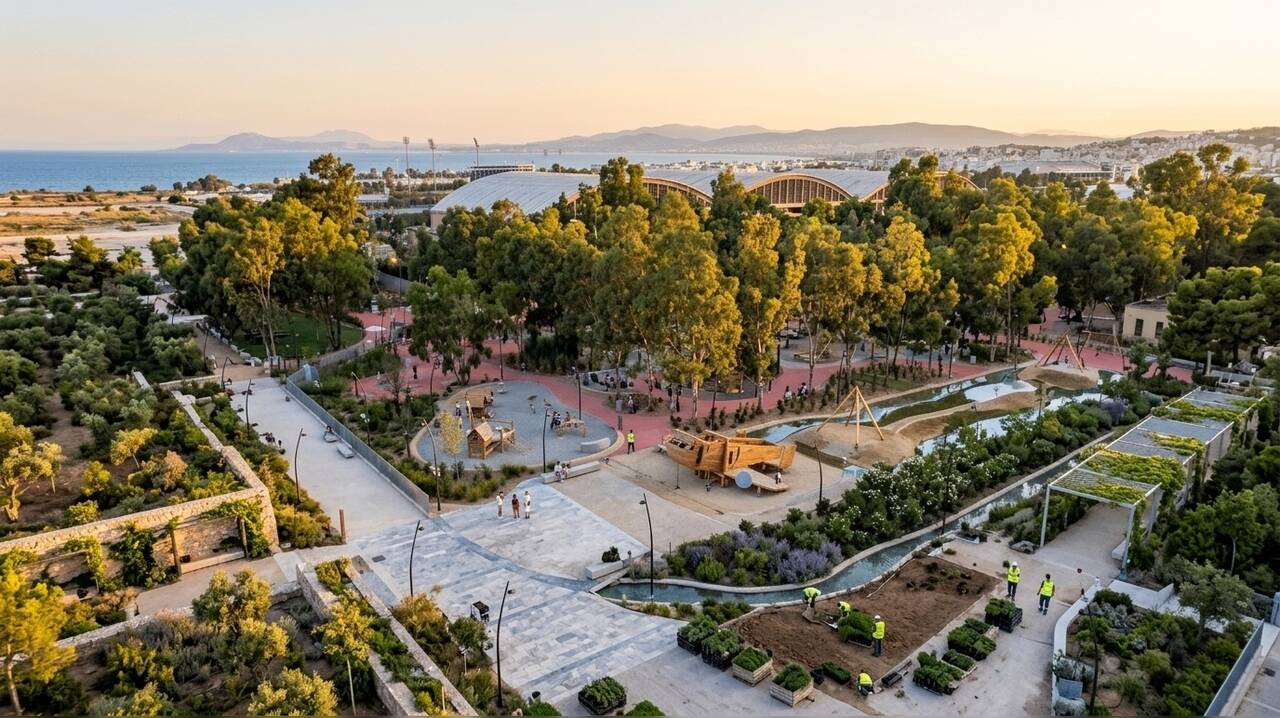
The Greek capital is currently undertaking one of Europe’s most ambitious urban regeneration projects, converting the site of a former international airport into a sprawling, climate-resilient green space. Known as
Designed to serve as a vital refuge for residents in one of Europe’s hottest cities, the park is being engineered with a primary focus on thermal regulation. By utilizing advanced simulations of air circulation, wind patterns, and evaporation, planners have created a network of pathways and vegetation zones intended to maintain temperatures significantly lower than the surrounding urban concrete and asphalt environment. The project is being developed under the guidance of landscape architect Dimitra Theochari and Lenio Myrivili, the UNEP Global Chief Heat Officer and Special Advisor for
Engineering a Climate-Resilient Landscape
The technical approach to Ellinikon Park emphasizes sustainability through both water management and material reuse. To address the city’s historical struggle with high temperatures and limited green space, the park will feature 30,000 trees and three million smaller plants, with approximately 75 percent of the flora consisting of native or climate-adapted species. These plants are strategically placed to enhance evapotranspiration, further cooling the local microclimate.
Water conservation is central to the site’s infrastructure. The park will include an on-site treatment facility capable of processing 7,000 cubic metres of water daily for non-potable use. Additionally, a smart irrigation system is expected to reduce water consumption by 90 percent. The design also incorporates blue and green infrastructure to manage 100 percent of rainwater on-site, including the restoration of the Trachones stream to act as a natural flood-protection measure.
Construction practices have also prioritized environmental impact by repurposing materials from the airport’s previous infrastructure. Hundreds of tons of demolished concrete and asphalt have been recycled to create structural elements such as retaining walls and plinths. For aesthetic and functional finishing, designers have selected traditional Greek stones, including Kavala and Dionysos-Penteli marble, chosen for their durability and ability to integrate with the natural Attic landscape.
A Significant Addition to Athens' Green Infrastructure
The scale of the project is substantial, with the park measuring 40 percent larger than London’s Hyde Park and nearly matching the size of Berlin’s Tiergarten. This development represents a major shift for Athens, a city that has faced challenges with urban density and extreme heat. The initiative follows other recent efforts by the city, including the planting of micro-forests and the addition of 5,000 trees across various neighborhoods.
The project is scheduled to open to the public next year, with further renovations and expansions planned through 2030. As Athens continues to address the impacts of rising temperatures, Ellinikon Park stands as a key component of the city's broader strategy to improve thermal comfort and environmental sustainability for its residents.




