
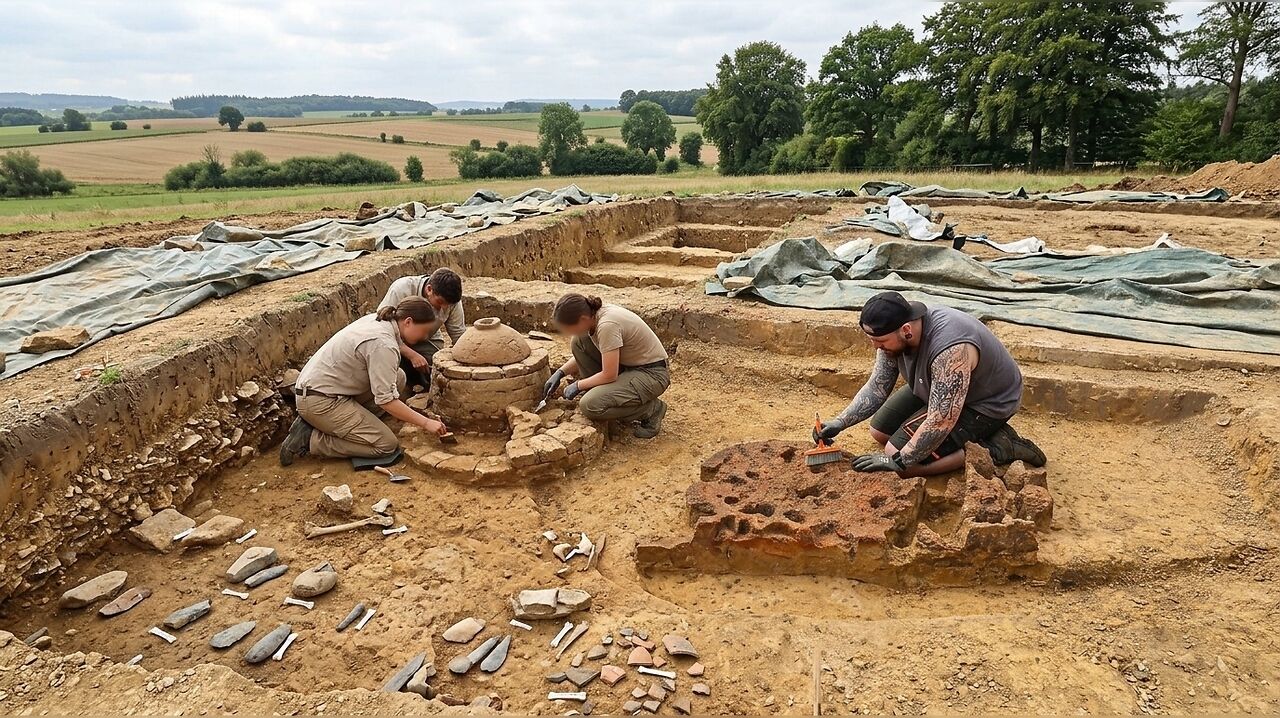
Archaeologists in western Dortmund, Germany, have unearthed a significant workshop complex dating back to the Roman Imperial period. The site, which spans a settlement occupied between the 1st and 5th centuries AD, contains a rare collection of furnaces, hearths, and pits that provide physical evidence of ancient industrial activity.
The excavation, a collaborative effort between the Landschaftsverband Westfalen-Lippe (LWL) and the Dortmund City Archaeology Department, began in mid-August. Among the most notable findings is the first pottery kiln ever discovered at this specific location, alongside exceptionally well-preserved workshops dedicated to metalworking. Experts have described the site as a unique discovery within the western Germanic settlement region.
Evidence of Roman Metal Recycling
The discovery offers a rare glimpse into how Germanic tribes processed materials during the Roman Imperial period. According to Jan Rosbeck of the Dortmund City Archaeology Department, the site served as a hub for recycling Roman scrap metal. The process involved melting down metal objects in crucibles placed within specialized kilns. These structures, characterized by their round or oval shapes and clay walls, utilized bellows to pump air into the chambers, allowing workers to regulate temperatures effectively.
Dr. Eva Cichy, the excavation director at the
Significance of the Germanic Workshop
The findings carry weight beyond the local region, as they provide tangible evidence of Germanic metal processing occurring outside the borders of the Roman Empire. While it has long been understood that Germanic tribes acquired Roman metal through trade or conflict, the physical remains of the recycling process itself have rarely been documented in such detail.
Professor Michael Baales of LWL Archaeology highlighted that the site confirms historical theories regarding the large-scale recycling of Roman goods. Tobias Zacharias, also of the Dortmund City Archaeology Department, added that the lack of prior archaeological documentation for such workshops makes this discovery particularly significant for understanding the broader technological capabilities of the era.
As the excavation nears its conclusion, researchers are still working to determine the specific types of pottery produced at the site. The team plans to recover the most well-preserved furnace to ensure it can be conserved and eventually displayed to the public, preserving this unique link to the region's ancient industrial history.




