
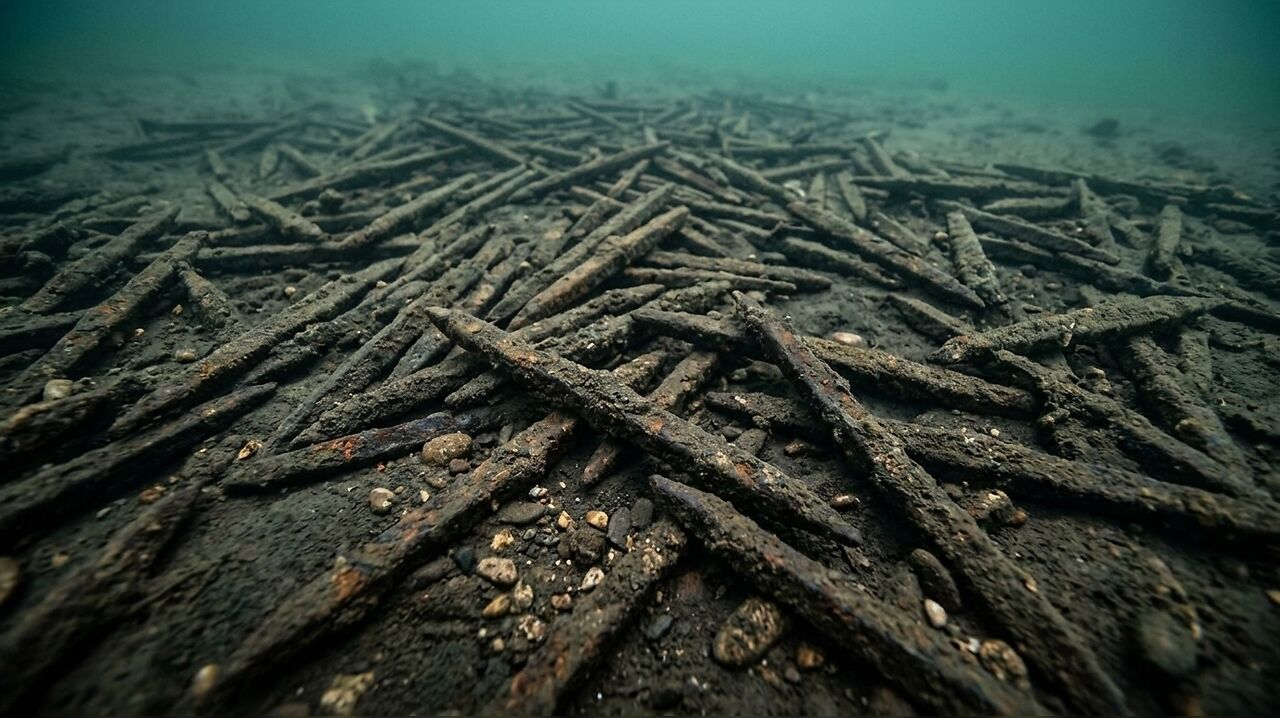
Archaeologists have identified a significant cache of more than 500 forged
The items were first unearthed in 2019 during commercial gravel extraction operations in the town of Deinham. Workers discovered the double-pointed objects within material dredged from beneath the river's water level. Although the industrial process disturbed the original archaeological site, the Federal Monuments Office was alerted, allowing for the subsequent collection of 540 fragments from the gravel heaps. Following analysis, researchers confirmed a minimum of 500 individual bars, which are now held by the Oberösterreichische Landes-Kultur GmbH in Linz.
Insights into Iron Age Trade and Production
A research article published by Cambridge University Press, titled 'A sunken ship cargo of 500 bipyramidal bars? Implications for La Tène period iron production and trade along the Danube,' details the findings. Radiocarbon dating performed on three of the bars indicates they originate from the Late Iron Age, specifically spanning the fourth to the first centuries BC. The researchers classified the items as a new variant of forged iron semi-products, rather than cast ingots, noting their distinct bipyramidal shape.
The bars are remarkably uniform, with complete examples measuring an average of 285mm in length. Their weight varies significantly, ranging from approximately 959g to over 3,800g, with an average weight of roughly 2,070g per bar. Collectively, the assemblage weighs approximately 1,035kg. Experts suggest that such a quantity of iron would have been sufficient to produce roughly 500 swords or as many as 8,000 nails, providing a rare glimpse into the industrial capacity of the era.
Evidence of Riverine Transport
The location of the find, within silted-up channels near the Eferding Basin, strongly supports the theory that the iron was being moved by water. While the original archaeological context was lost during the gravel extraction, preventing the discovery of any accompanying vessel, researchers believe the uniform nature of the cargo points toward a commercial shipment rather than a ritual deposit. They suggest that Late Iron Age logboats were capable of carrying loads exceeding one tonne, making river transport the most plausible explanation for the presence of such a large quantity of metal in this specific location.
The study identifies the region encompassing Manching, Kelheim, and the Upper Palatinate as the most likely origin for the cargo, indicating that the iron was transported a significant distance downstream before being lost. The discovery remains a vital piece of evidence for understanding the scale of iron production and the complexity of trade networks in Central Europe during the third and second centuries BC.




